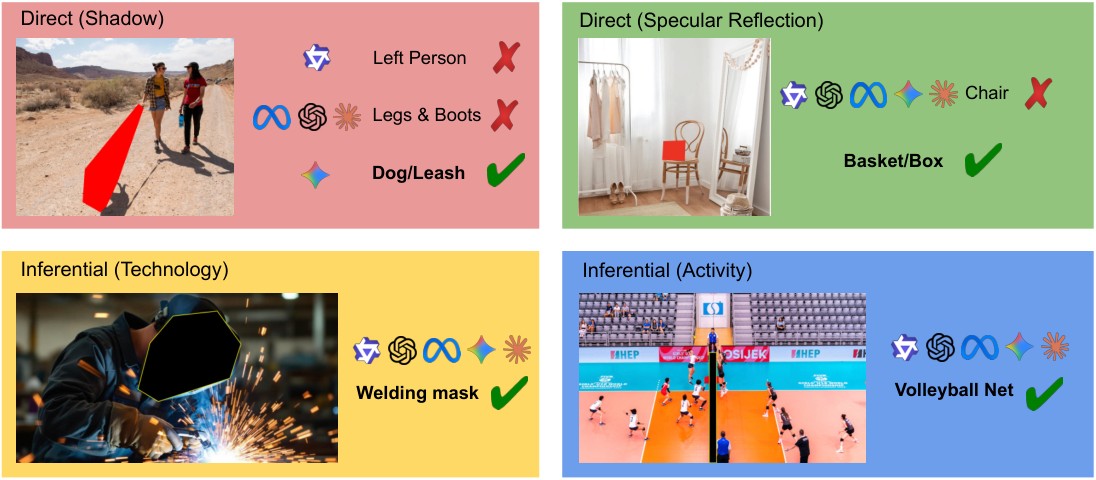
A kitchen scene can suggest a hidden kettle from familiar context. A shadow or reflection may identify an occluded object much more specifically—and prove harder for a vision model.
OccludeBench's October 9 paper separates direct physical cues from broader inference. Evaluated models show a substantial gap between those categories. A diagnostic pipeline locates difficulty recovering an object from its projection within the full image. Read the research paper.
A plausible guess is not the same as grounded recovery
Context can supply an answer without requiring the model to interpret the visible clue. That shortcut is useful until the scene contains an unusual object or deliberately misleading arrangement.
The authors test an image-generation intervention that proposes a hidden object and checks it against the cue. Improvements on tested systems do not show that imagined content is generally reliable evidence.
For robotics, test shadows, reflections and partial views separately from conventional object recognition. A robot deciding whether a space is occupied needs the cue to constrain its hypothesis.
The benchmark's contribution is to make missing content measurable without rewarding only familiar-scene guessing. More reasoning text is not necessarily the remedy when the bottleneck is recovering what the physical image actually implies.
Questions, news tips or corrections? Contact [email protected].