A simulated grasp can look smooth while predicting success for an action that drops the object. Visual plausibility is not the property a planner needs most.
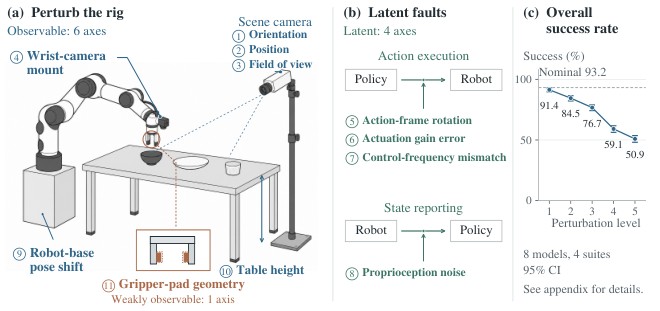
WorldOracle's October 13 paper pairs initial observations and low-level action sequences with real executions. Its evaluation examines physical state, spatial alignment, interaction regions and multi-view coherence, including both successful and failed episodes. Read the research paper.
Failure is part of the evidence distribution
A world model evaluated only on successful demonstrations can learn to make every rollout end well. Predicting failure when an action is unsuitable is essential if the model is meant to choose among actions.
Matched executions constrain the question: given this state and this command sequence, did the forecast reproduce the relevant consequences? That is different from asking whether a video looks realistic to a viewer.
The proposed benchmark and seven-model experiments cover selected embodiments and dynamics. The paper's announced releases should not be described as already available without checking project status.
For physical AI, this is the decisive evaluation boundary. A world model earns planning value when its errors track action consequences closely enough to change a decision. Attractive generated footage can demonstrate a capability, but cannot by itself establish that the imagined world is a reliable place to practise.
Questions, news tips or corrections? Contact [email protected].