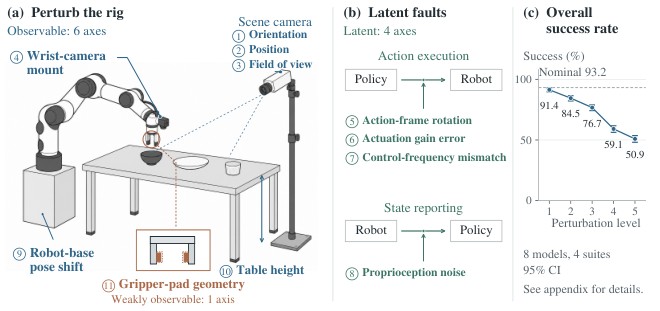
A camera moves a little, a gripper pad wears down or a controller runs at a different rate. The task has not changed, but the policy's input-output relationship has.
LIBERO-RIG, posted October 13, varies hardware and setup along eleven axes while keeping LIBERO tasks fixed. The authors report substantial degradation across evaluated policies, with differences between perturbation types and action interfaces. Read the research paper.
Visual robustness does not cover invisible faults
Some changes alter the image. Others alter actuation while leaving the view unchanged. Training with camera perturbations cannot be expected to correct a controller mismatch it never represented.
The benchmark is a controlled evaluation of setup sensitivity, not a measurement of all physical wear in deployed robots. Its parameter manifests help make comparisons repeatable.
For deployments, test camera remounting, calibration drift and control-rate changes separately. Logging only scene variation can miss the conditions introduced by maintenance or replacement hardware.
The result shifts part of generalisation from the external world to the robot itself. A policy does not merely need to recognise new objects. It needs either tolerance of, or a way to identify, changes in the machine through which its learned commands become physical motion.
References
Questions, news tips or corrections? Contact [email protected].