Robot imitation learning turns demonstrations into many small prediction problems: given this observation, reproduce the expert’s action. The training objective commonly averages errors across those moments. But task success does not average consequences in the same way. A harmless deviation during an approach and a tiny slip during insertion can receive similar statistical treatment while producing radically different outcomes.
The question behind SCRIM is therefore about the unit of useful data. Should a demonstration be valued by its length, its variety or the moments when a small mistake becomes difficult to recover from? The paper develops a consequence-based answer, moving attention from how much movement was recorded to where precision changes the result.
A critic estimates the cost of a deviation
SCRIM's October 13 paper estimates state criticality by examining how bounded action perturbations affect downstream value. The resulting scores support loss reweighting and compact demonstration selection in simulated and real manipulation tasks. Read the research paper.
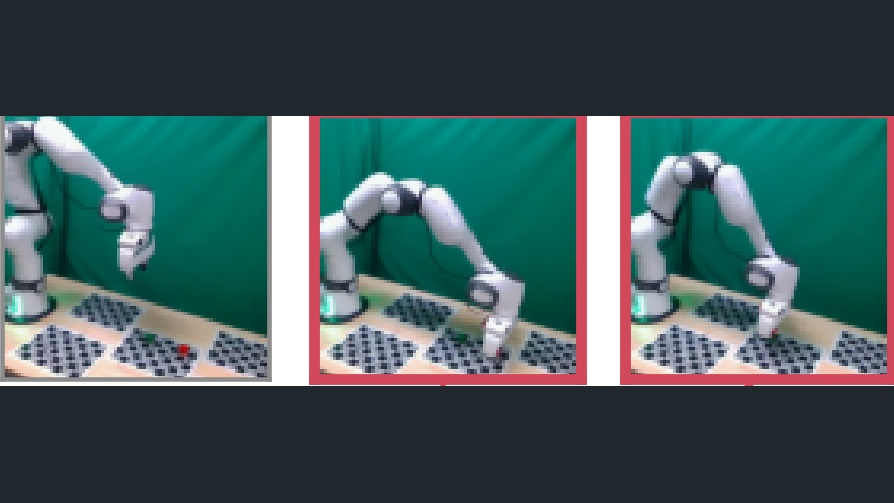
The proposed criticality measure asks how much downstream value can deteriorate under a bounded perturbation to an expert action. In practice, SCRIM trains an adversarial disturbance policy and a value critic around a fixed imitation policy. The resulting score estimates vulnerability at a particular state under that setup.
This is more specific than simply detecting unusual images or large changes in the gripper trajectory. A visually quiet moment can be highly consequential. Conversely, a dramatic movement may be forgiving if the controller can readily recover. Criticality is about the relationship between an error and the remaining task, not appearance alone.
A compact subset must still cover recovery
SCRIM’s data-curation use raises a distinction between concentrating on vulnerable states and deleting everything around them. The few decisive frames may show where precision matters, but surrounding observations can explain how the robot arrives there and what a successful recovery looks like. A selected demonstration is a sequence, not just a bag of independent action labels.
For a training team, this suggests examining the structure of retained episodes as well as the number of retained states. A compact subset that preserves critical moments but loses the approach distribution could expose the learner to states it rarely reaches correctly. This is a proposed interpretation to test, not a failure established by the paper. The authors’ success with consequence-based selection makes the question worth asking: which contextual portions are necessary to make a high-criticality example learnable? It is a different issue from whether the criticality score itself identifies vulnerable moments.
Selection and weighting answer different needs
The scores can alter the loss applied to states already in the training set, or select a smaller collection of demonstrations. Reweighting retains broad coverage while increasing attention to vulnerable moments. Selection changes the evidence available altogether. Those interventions should be compared separately when an organisation decides whether to save training compute or reduce collection and storage.
The paper reports improvements across simulated and real robotic manipulation tasks. Without carrying the complete experimental conditions into a deployment claim, the supported conclusion is that consequence-aware weighting and curation can help the evaluated imitation policies. It is not that every quiet segment of a demonstration is expendable.
Data collection should follow the student
A useful follow-up is to inspect whether a newly trained policy still finds the same states critical. The scoring system is built around a particular controller and disturbance range. As the controller improves, yesterday’s bottleneck may become routine and another failure point may dominate. A fixed ranking could eventually concentrate training effort in the wrong place.
That suggests a practical feedback loop for demonstration programmes: diagnose where current errors become consequential, collect or weight evidence there, then repeat the diagnosis. This is an implication of the measure, not a reported unlimited self-improvement capability. The important shift is from accumulating hours to understanding which seconds the learner cannot afford to misunderstand.
References
Questions, news tips or corrections? Contact [email protected].