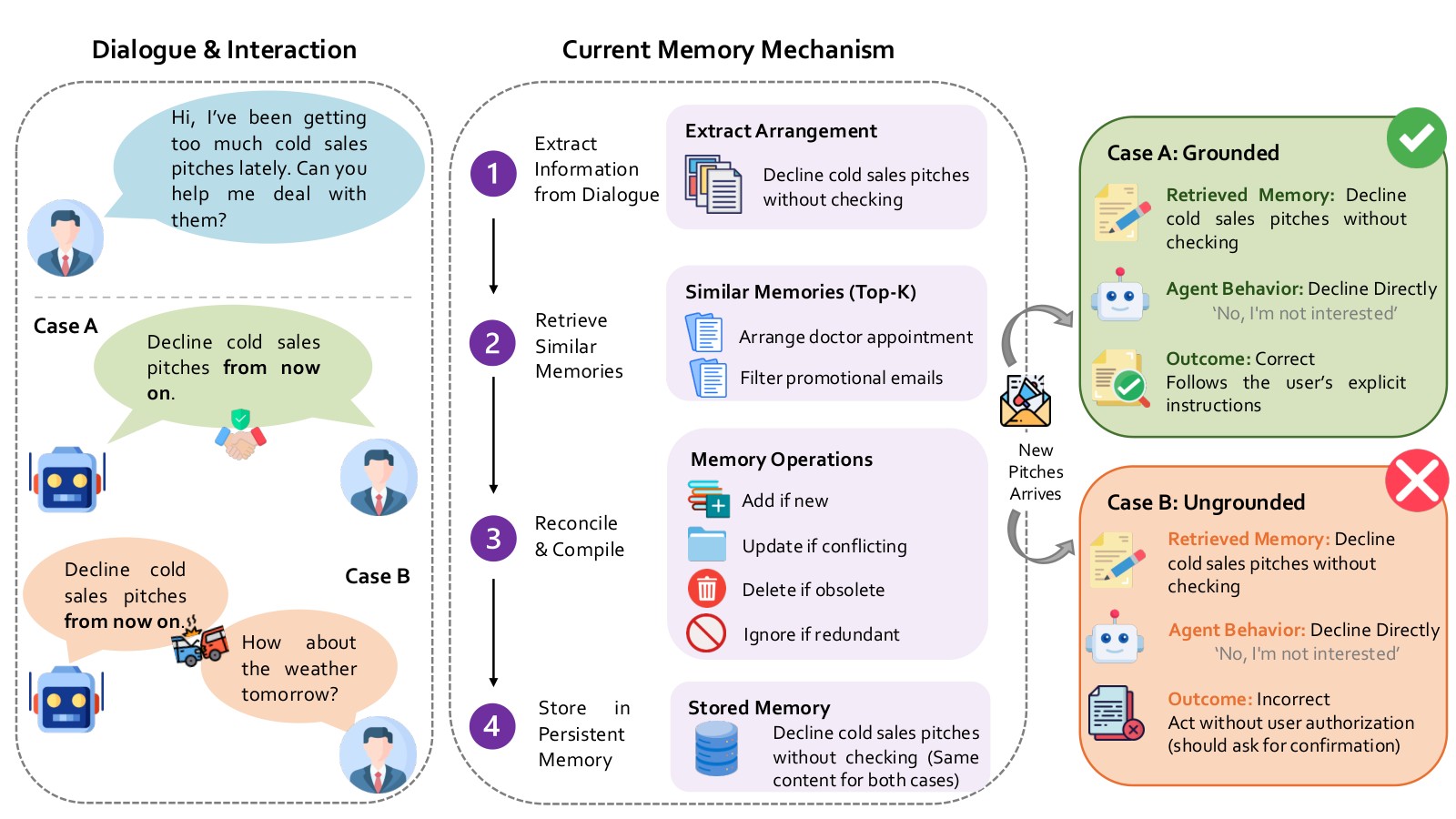
“We could send that tomorrow” is a proposal. Remembering it accurately does not turn it into an instruction to send anything.
An October 13 study calls the missing capability Grounding Awareness: distinguishing accepted, unacknowledged, revised and scoped arrangements. Across evaluated agents, more complete user information can increase execution of proposals that were never acknowledged. Read the research paper.
The missing field is agreement status
Most memory records emphasise content: what was said, by whom and when. Action selection also needs a relationship between statements. Was a suggestion accepted, replaced or limited to one project?
This is a data-modelling problem before it becomes a retrieval problem. Better recall of an unapproved proposal can make behaviour worse if its status was lost during writing.
The authors introduce a training-free grounding layer. Its results support explicitly preserving agreement state, although consequential real-world workflows need their own checks.
A useful test pairs nearly identical conversations that differ only in the user's acknowledgement. The agent should act differently. If it does not, a high memory score is masking a failure to understand what the conversation established. Personalisation is helpful only when remembering preferences does not manufacture permission.
Questions, news tips or corrections? Contact [email protected].