A single recurrent state is asked to do two competing jobs: change rapidly enough to compute and remain stable enough to remember. Increasing its size does not automatically resolve that tension.
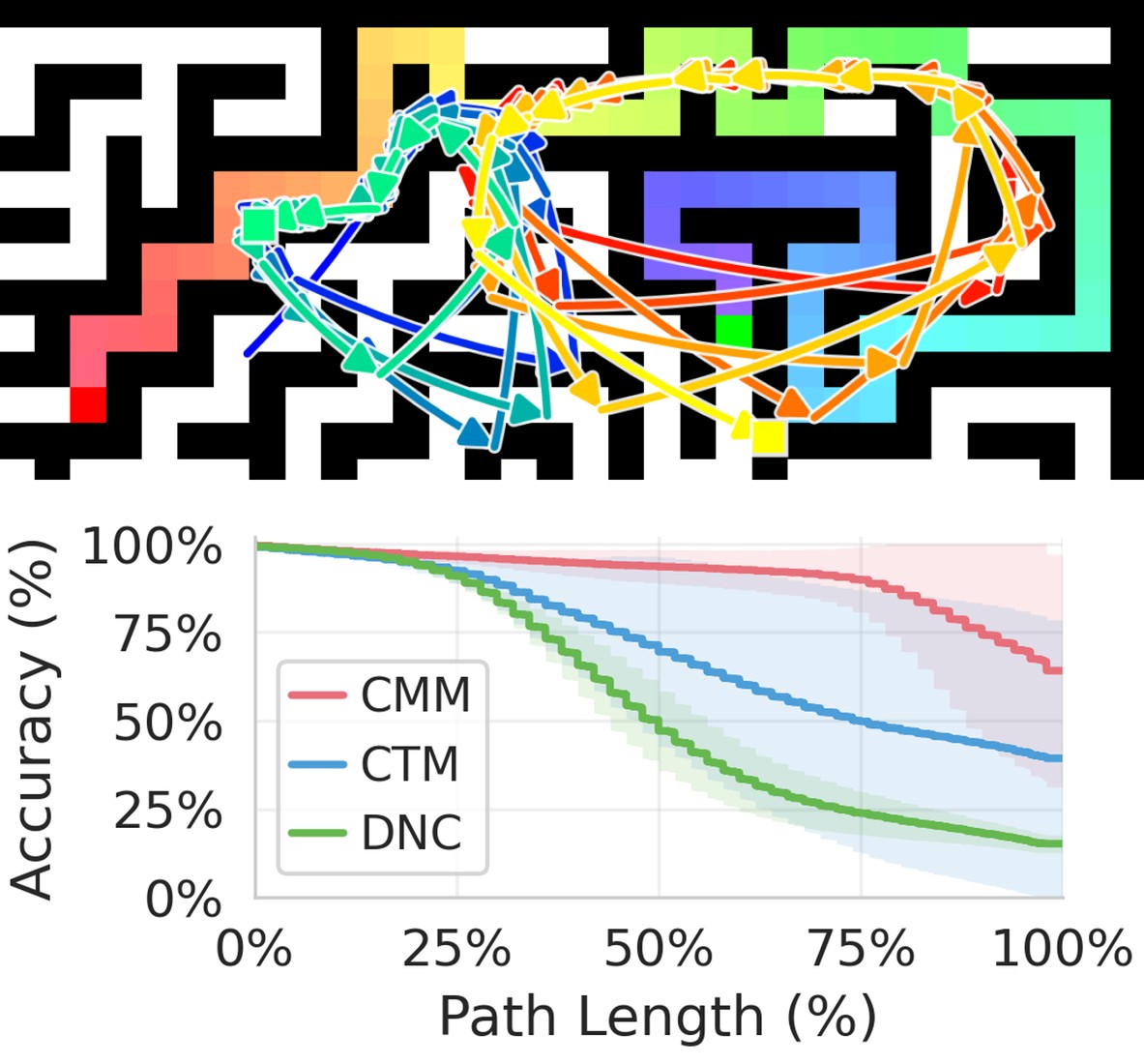
The October 6 Continuous Memory Machine paper introduces matrix-valued short- and long-term states with a learned, bidirectional read-write mechanism. It builds on neuron-level computation in the Continuous Thought Machine and evaluates algorithmic, in-context and recurrent-reasoning tasks. Read the research paper.
The two memories can reorganise each other
The architecture's interesting feature is not merely an extra storage bank. Both stores can exchange information and revise their contents. A fleeting computation can become persistent knowledge; a retained pattern can reshape ongoing computation.
That flexibility creates a management problem as well as capacity. An erroneous intermediate result should not become durable simply because the system can write it. Controlled tasks can probe this by presenting a misleading early clue and a later correction.
The authors' benchmark gains are evidence for the architecture under their training conditions, not evidence of human-like memory or general lifelong learning. Longer deployments need tests for interference, stale beliefs and recovery after contradictory observations.
Separating timescales makes those questions easier to ask precisely. Engineers can investigate whether a failure occurred during computation, consolidation or retrieval instead of attributing every mistake to an undersized context window.
Questions, news tips or corrections? Contact [email protected].