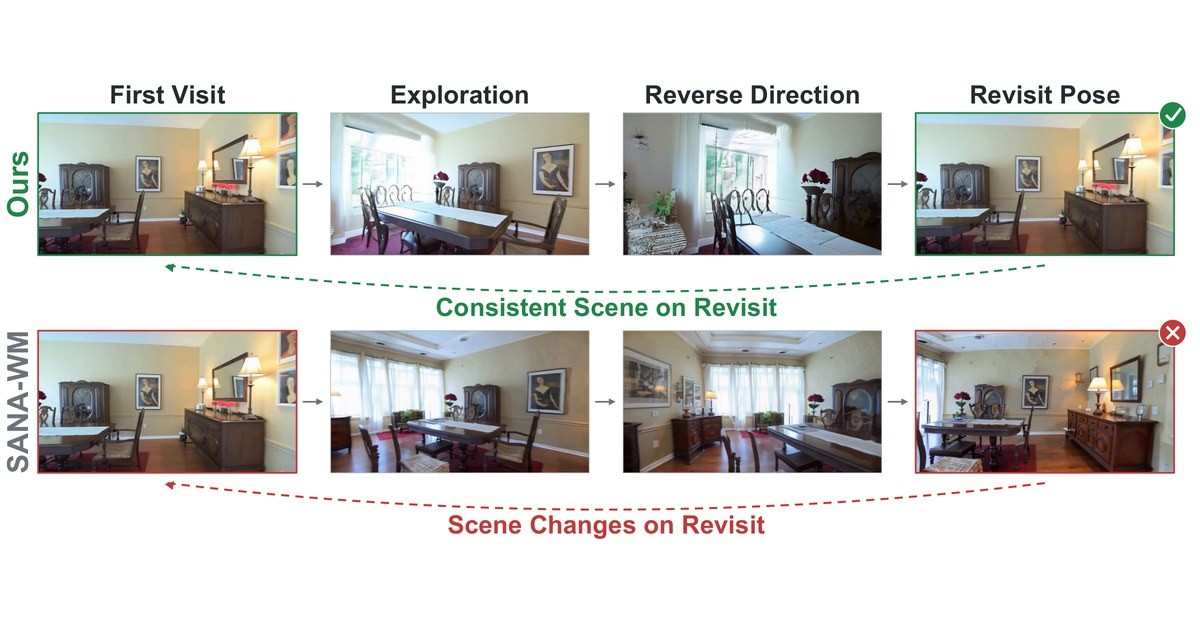
Walk away from a room in a generated world, then return. If the furniture changes, the model has produced plausible frames while failing to preserve a place.
World-T3, posted October 12, consolidates observations into dedicated fast weights. Pose-keyed updates and readouts let the system recover scene features beyond its active context. The authors report improved revisit quality and real-time generation on a single NVIDIA B200. Read the research paper.
Constant storage changes the failure to look for
The interesting architectural choice is to make memory a continually updated model state rather than an expanding archive of frames. That can avoid history-dependent storage growth. It cannot make finite memory preserve unlimited scene detail perfectly.
An engineer should therefore ask which observations interfere when they are consolidated. Repeatedly revisit similar-looking rooms, alter a small object, and return after a long excursion. Those tests expose whether later writes overwrite earlier distinctions.
The published benchmark supports improved consistency under its camera-controlled setting. It does not establish general physical correctness or a robot-ready simulator. World-T3 nevertheless separates two jobs often assigned to one generator: imagining the next view and maintaining evidence of the views already encountered. A world that looks convincing is only useful for planning if it also stays the same world.
A contrasting memory design appears in Memento 3, posted October 8. A frozen language model revises a natural-language rulebook, compiles it into executable dynamics code and checks observed transitions. World-T3 consolidates visual history into dedicated parameters; Memento keeps explicit hypotheses outside the backbone. Those stores differ in how easily a user can inspect, correct and withdraw a mistaken belief.
References
Questions, news tips or corrections? Contact [email protected].