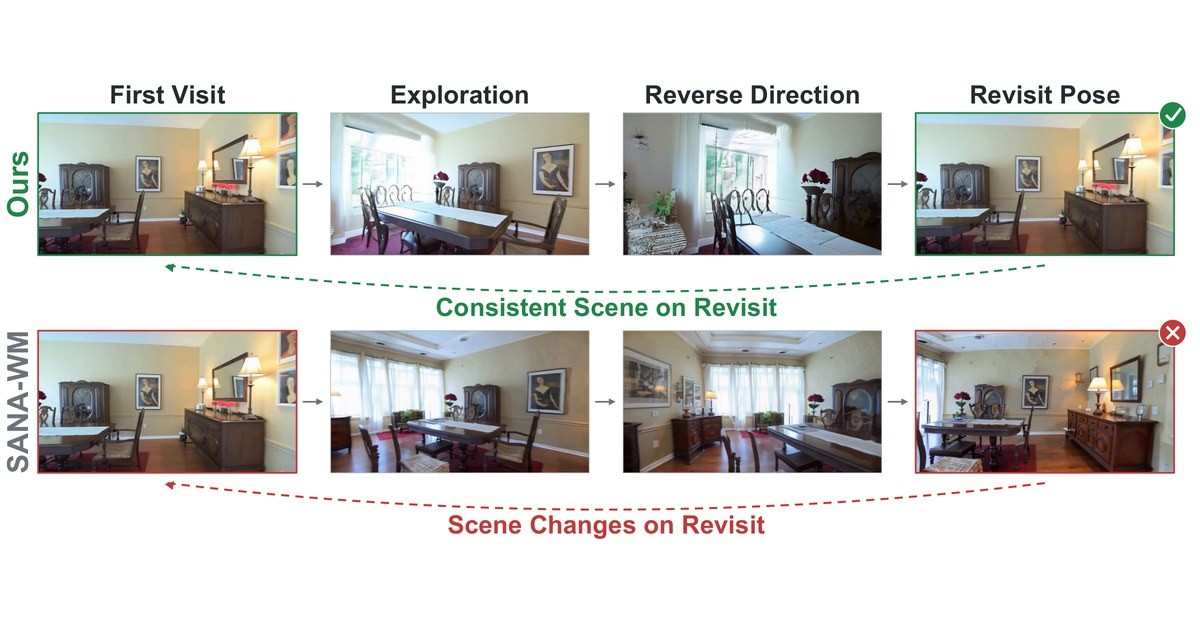
A robot remembering a red doorway has retained a fact. A robot remembering which direction it faced when it saw that doorway has retained a usable navigation clue.
MemoryVLN combines semantic and geometric tokens with agent poses, compresses history with denser recent observations, and reuses selected memories across contexts. Its October 13 paper reports improvements on R2R-CE and RxR-CE navigation evaluations. Read the research paper.
Retrieval has to survive a change of viewpoint
Two observations of the same room can look very different. Conversely, two similar doors can belong to different corridors. Semantic similarity alone cannot settle either case. Coordinates and orientation give retrieval a reference frame in which apparent matches can be checked.
Cross-context reuse adds a harder question: should the robot trust its old map? A relocated chair can leave the room description accurate while making the remembered route obsolete. MemoryVLN's confidence-controlled write-back addresses part of this management problem; the benchmark results should not be read as proof of indefinite map freshness.
For deployments, test returning to a previously explored room after rearrangement. Measure whether memory reduces exploration without increasing confidently wrong turns. The value of persistent spatial memory lies in useful reuse, and useful reuse includes recognising when the past has stopped describing the present.
Questions, news tips or corrections? Contact [email protected].