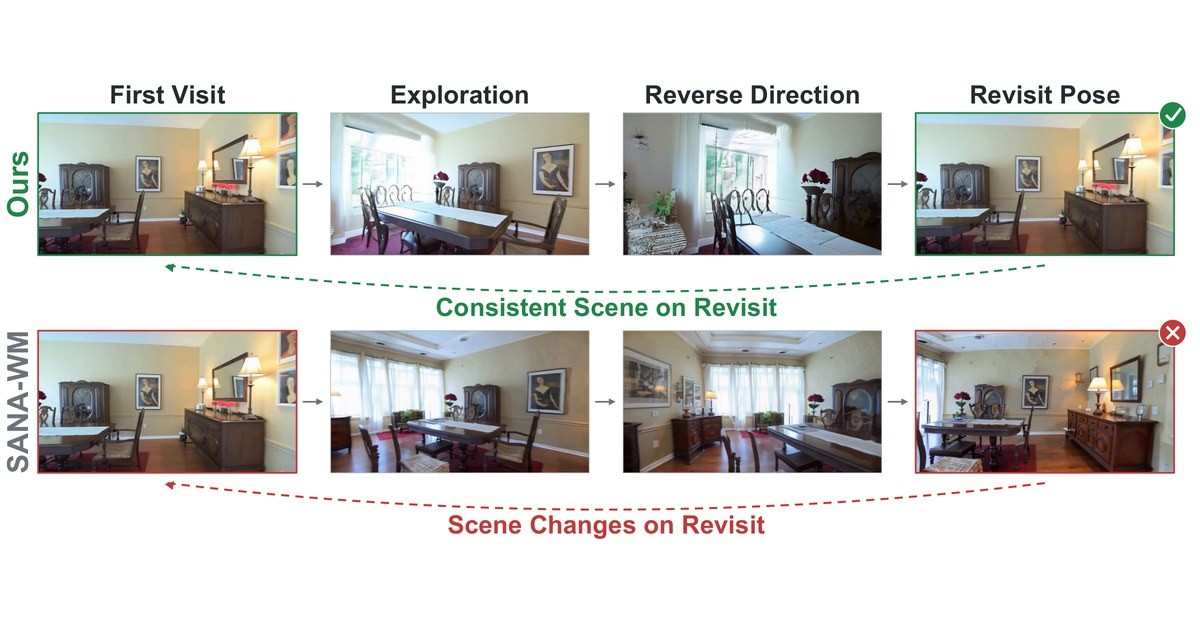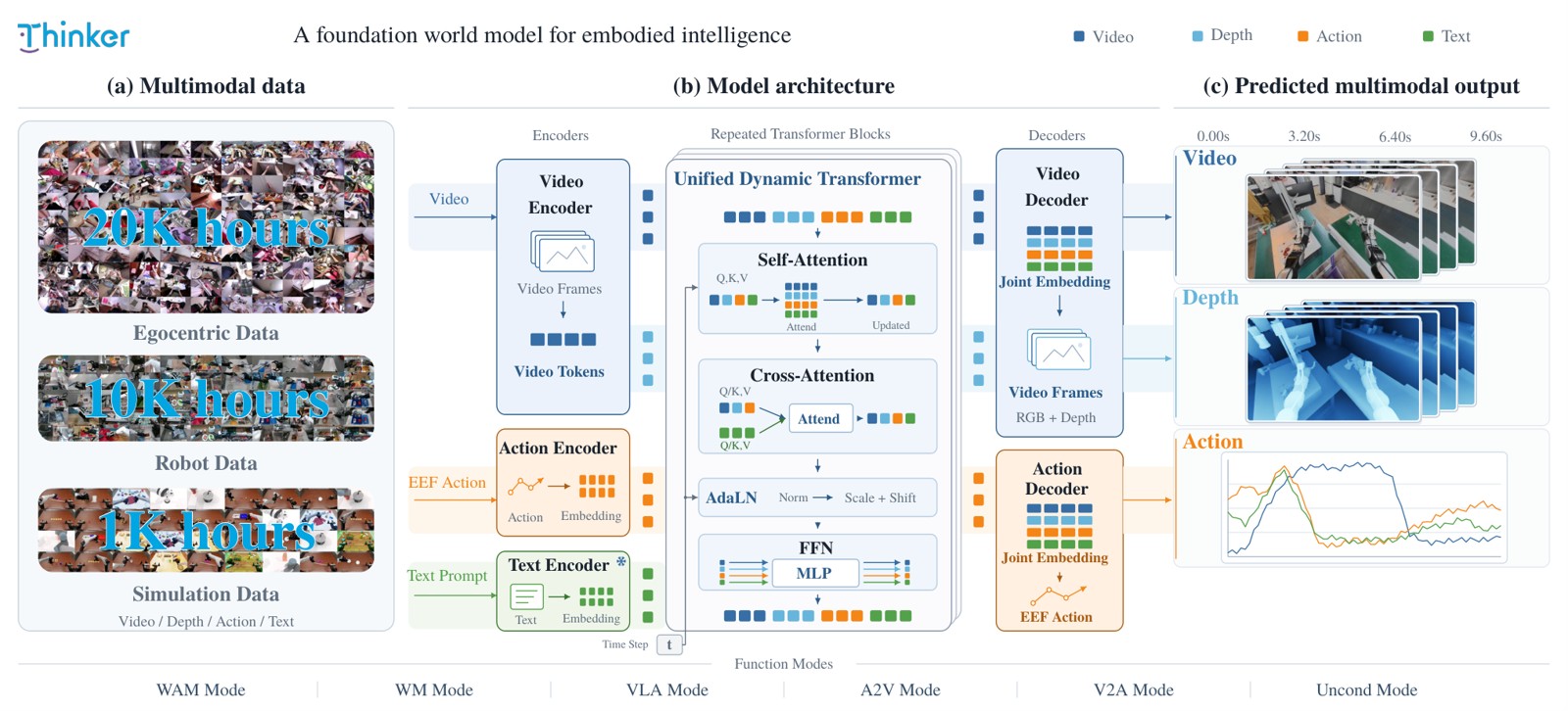
A video predictor can make a plausible scene without producing metric depth or executable action. Adding those outputs afterward does not guarantee that they describe the same underlying event.
Thinker-WM, introduced October 13, maps appearance, geometry and action into a shared dynamics representation while retaining modality-specific encoders and decoders. The authors train on human video, robot data and simulation, with depth supervision available for part of the robot corpus. Read the research paper.
Joint prediction creates a consistency test
The useful opportunity is to ask whether outputs agree. If a predicted grasp succeeds in video but its action misses the object in geometry, the model has not learned a coherent interaction merely because each output looks credible separately.
The paper reports benchmark leadership and controlled studies of its training choices. A recoverable motion signal in frozen features is encouraging, but recoverability alone does not prove that every generated action uses that signal.
Test cross-output consistency under interventions: move the object, change its scale or alter the action while retaining the scene. The predicted consequences should change together.
Unified representations offer more than parameter sharing when they constrain one another. They also risk spreading a mistaken visual assumption into depth and control. A model's modalities should therefore be evaluated as a coupled system, not only as separate leaderboard entries.
Questions, news tips or corrections? Contact [email protected].