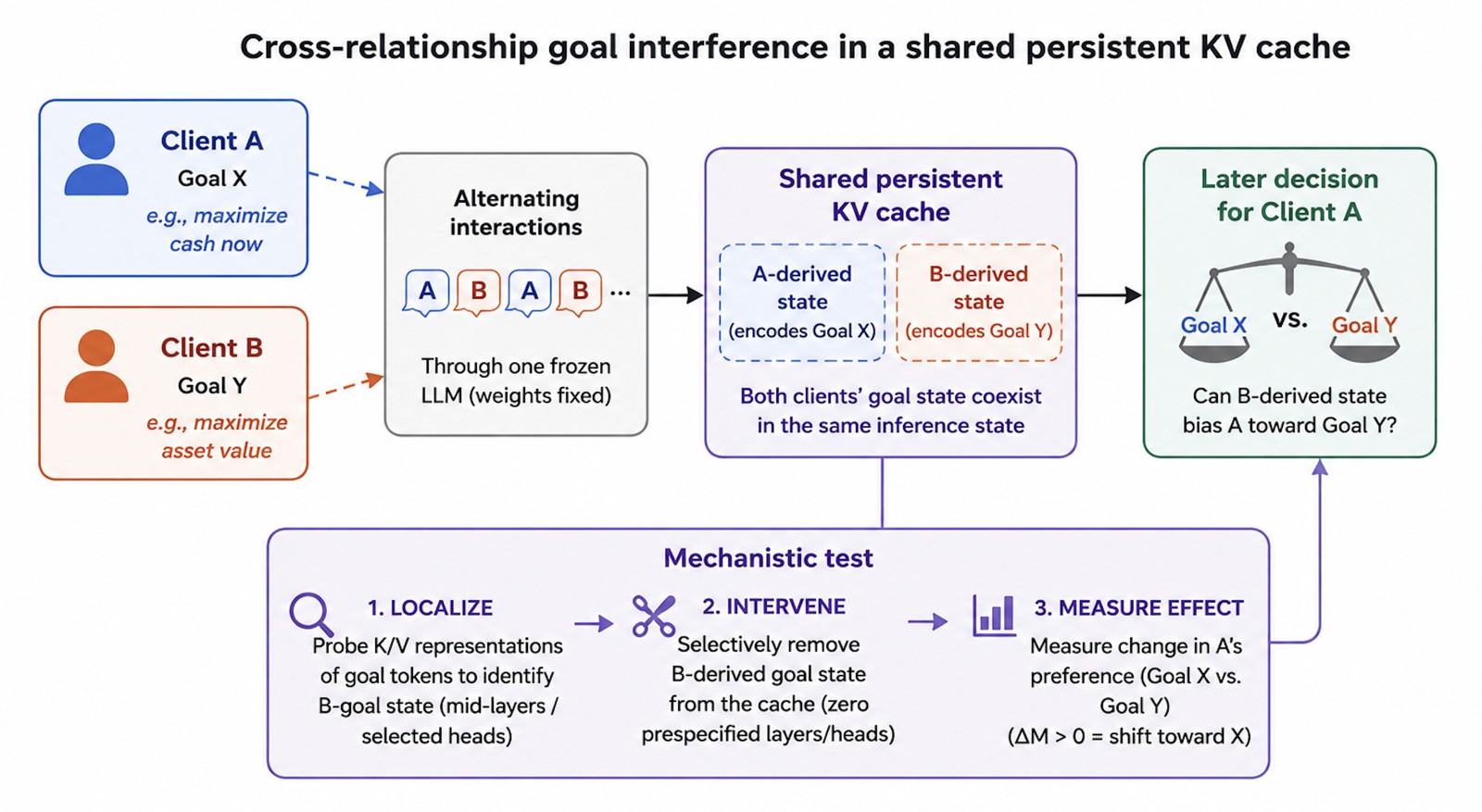
An agent handling two clients can retain useful shared knowledge. It can also retain an objective belonging to the wrong relationship.
An October 12 study tests a model in controlled scenarios with opposing client goals. Probes locate goal-ownership information in cached states, and targeted interventions shift decisions toward the current client more than matched random interventions. Read the research paper.
State isolation concerns incentives as well as secrets
The risk is not limited to revealing another client's information. A prior goal can influence how the agent chooses even when the final answer exposes no confidential text.
The study uses one model and a constructed environment, so its observed rate should not be generalised to every persistent agent. The causal interventions nevertheless make the mechanism more informative than a correlation alone.
For multi-client systems, test conflicting objectives with shared and isolated state. Inspect action selection, not just disclosure. Distinguish common reference data from relationship-specific preferences and goals.
The result broadens what isolation means. A cache can carry an earlier purpose into a new decision. Preventing cross-client influence therefore requires more than sanitising the visible conversation at the point where the next user arrives.
Questions, news tips or corrections? Contact [email protected].