In an ordinary transcript, a missing article may be a nuisance. In a spoken instruction to a machine, a changed number can alter the job.
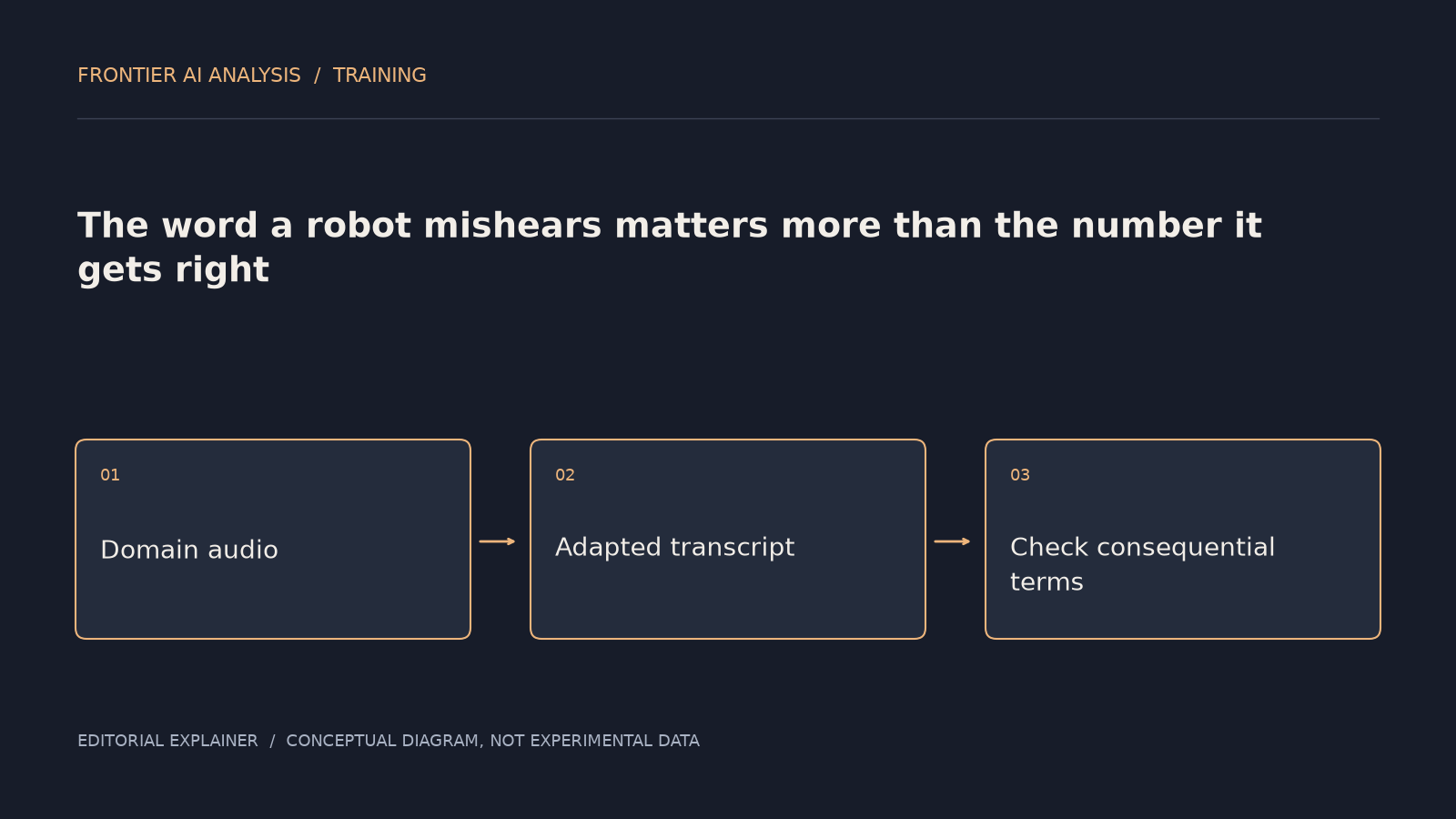
NVIDIA’s October 13 speech-adaptation study reports reducing Nemotron’s word error rate on a two-hour, human-annotated air-traffic-control test from 77.00 to 22.46 percent. General-English error moves from 3.50 to 3.63 percent. The recipe first adapts on a broad, machine-labelled domain pool, then refines on trusted labels while replaying general English.
Those are transcription results. They do not validate an autonomous aviation system. For physical-AI developers, the interesting issue is how a large average improvement should translate into a test of the few words that control an action.
Errors are not equally expensive
Word error rate counts substitutions, insertions and deletions relative to a reference. It is useful for comparing recognisers under a consistent protocol. It does not assign extra weight to the token that changes a destination, quantity or machine identifier.
Imagine two hypothetical voice interfaces with the same overall error rate. One occasionally drops polite filler but transcribes part numbers correctly. The other preserves the filler and confuses similar identifiers. Their scores can look alike while their usefulness on a production floor differs sharply.
A deployment evaluation should retain the general score and add a task-relevant one. Exact identifier match, numeric-value accuracy and the frequency of ambiguous commands would expose errors that a word average can dilute. The important step is defining those fields before looking at the results, so the test does not become a retrospective defence of a favoured model.
Familiar language can be a misleading prior
Domain adaptation helps because specialised speech has distinctive vocabulary and acoustic conditions. But a preference for familiar phrases also needs scrutiny. An unusual but valid call sign or part number should not be silently normalised into the common one.
One useful test would vary rare identifiers while holding the surrounding phrase constant. Another would deliberately include close-sounding alternatives. These are proposed evaluations for a physical interface, not outcomes established by NVIDIA’s tutorial.
The staged recipe offers a separate lesson about labels. A large noisy pool can supply coverage; a smaller trusted set can correct the direction of learning. Combining every available example into one undifferentiated final stage need not make the best use of either source.
For a robot, the speech model is only the first listener. A command parser and execution policy still have to decide what to do with an uncertain transcript. The system should preserve that uncertainty long enough to ask a useful follow-up. A beautifully punctuated instruction is little comfort if it confidently names the wrong component.
References
Questions, news tips or corrections? Contact [email protected].