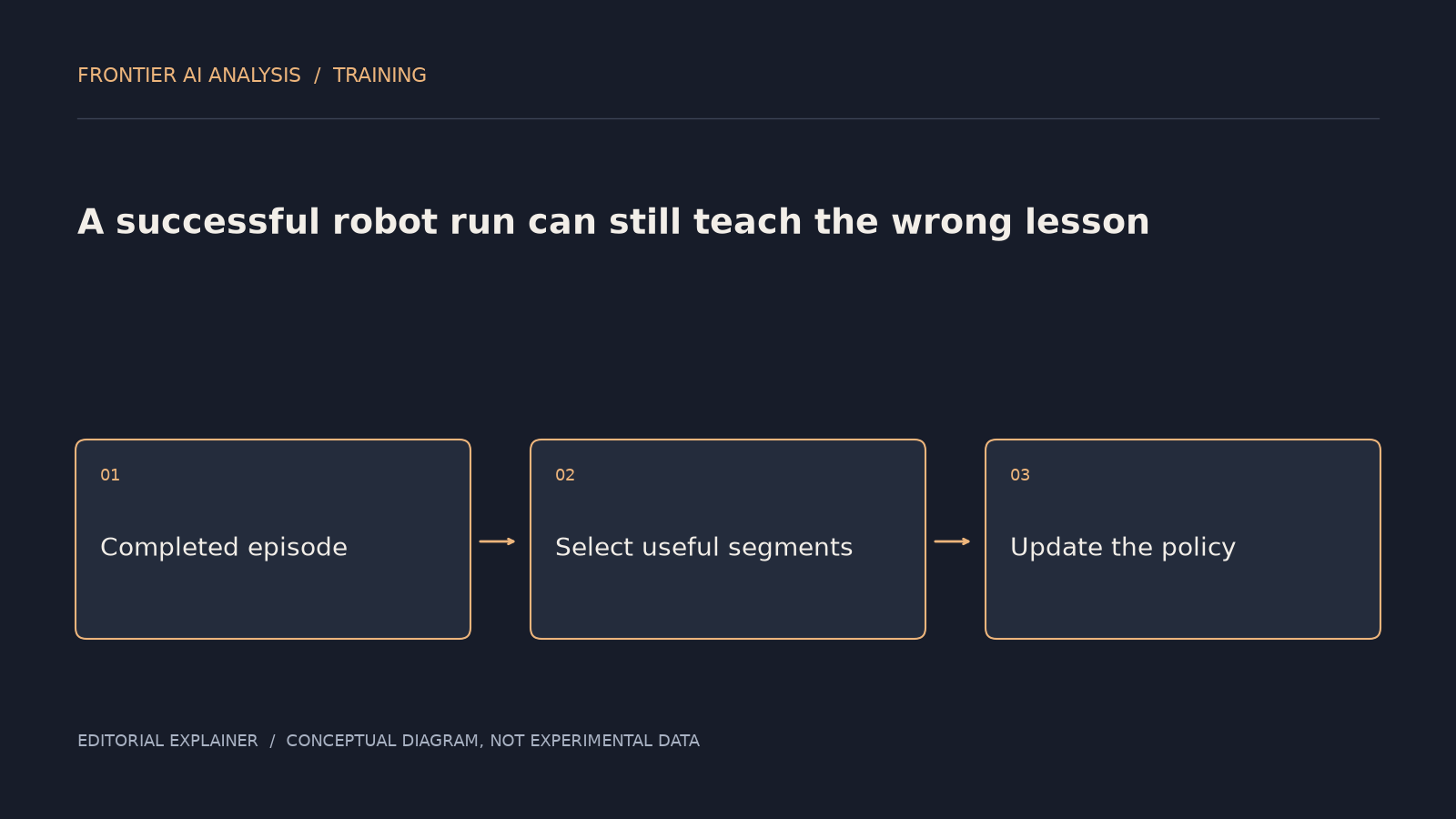
A robot can miss a grasp, reposition twice, hesitate and finally finish the job. Label the whole recording “success” and the recovery arrives bundled with the mistakes that made it necessary.
Evo-RL, posted October 9, tries to make that bundle more selective. The method combines human corrections with experience segments from successful trajectories whose estimated advantages are positive. Its authors also introduce a dataset spanning more than 1,000 hours and four robot embodiments, and report improvements on a real high-precision manipulation task.
An advantage estimate asks whether an action was better than the policy’s expected alternative in that state. It supplies a more discriminating learning signal than the fact that the final outcome was acceptable.
Success is an outcome, not a complete annotation
The distinction matters whenever a robot gets multiple chances. A completed episode can contain actions that waste time, increase wear or move the task away from completion. If all of them are copied as desirable behaviour, an imitation learner may preserve the detour along with the successful ending.
Conversely, a failed episode can contain a good response to a difficult situation. A late failure does not retroactively make every earlier action wrong. Selecting experience at a finer level offers a way to separate these contributions, although the particular Evo-RL method uses positive estimated advantages from successful trajectories alongside corrections.
The editorial implication is that data quality should sometimes be assigned to a decision in context rather than to a whole video. That changes the unit of curation. A collector needs enough state and timing information to understand why a segment helped, not just a binary outcome attached at the end.
Selection can create its own blind spot
There is a risk in trusting the selector too much. An advantage estimate is itself learned or estimated. If it systematically underrates difficult recovery behaviour, a policy could lose the examples that teach it how to escape trouble.
A useful audit would therefore compare the selected and discarded segments by function: initial attempts, corrections, retries and recovery. It would then test whether faster nominal completion comes at the cost of worse performance after a disturbance. Such an audit would examine the selection mechanism, rather than assuming that higher estimated advantage means universally better data.
Human interventions deserve similar care. They can reveal exactly where the policy’s judgement diverged from an operator’s, but that does not make every correction equally informative. A rescue caused by a mechanical fault teaches a different lesson from one caused by a planning error.
The practical prize is a learning loop that gets more from experience already paid for. The robot does not necessarily need another thousand hours of repeating a task. It may first need a better account of which seconds in the hours it already has were worth repeating.
References
Questions, news tips or corrections? Contact [email protected].