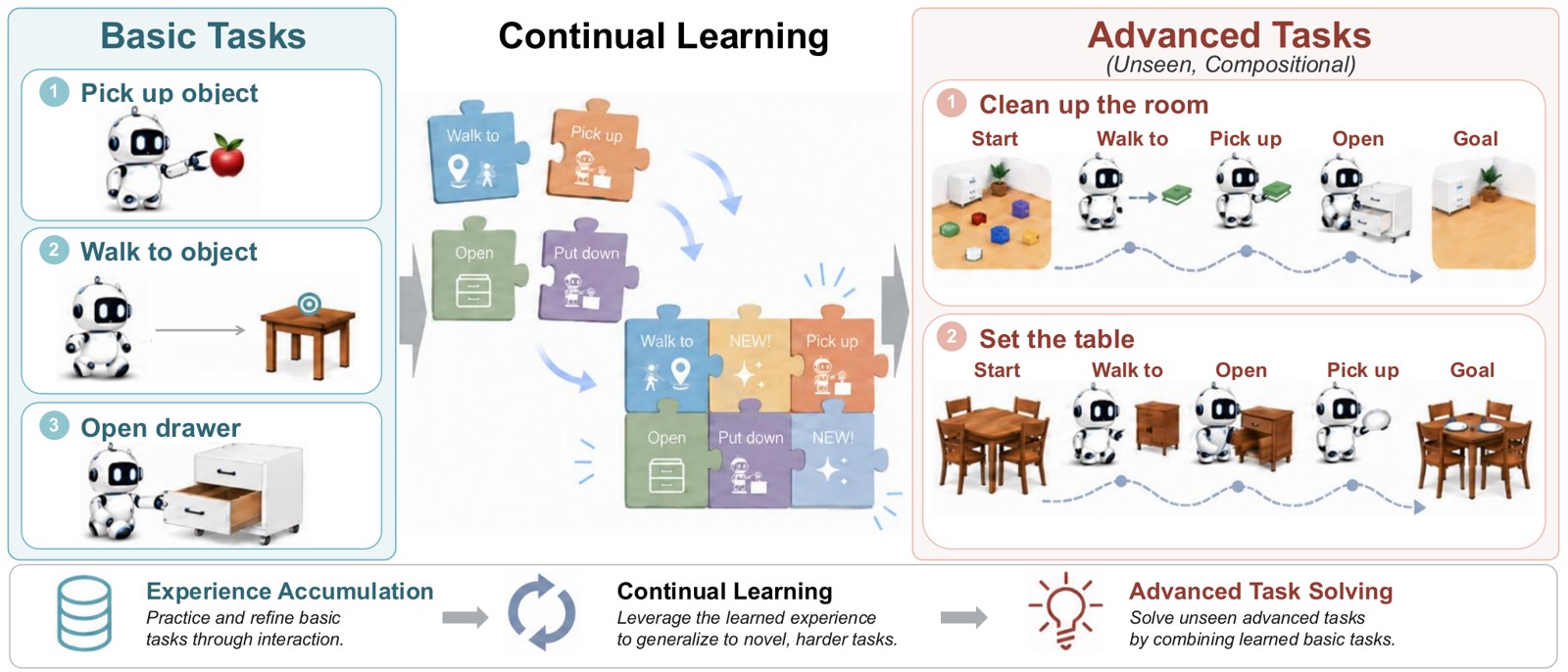
An agent can learn several basic tasks and improve on a harder combination. Add more examples, however, and improvement may barely move.
EmbodiedCLBench's October 9 paper evaluates compositional continual learning in embodied simulation. The authors find benefits from basic-task experience, alongside limits in how those benefits scale with additional samples. Read the research paper.
Accumulation is not the same as extraction
More episodes provide more opportunities to learn, but a memory or training procedure must identify the reusable structure. Repeating similar success traces may add volume without improving composition.
The benchmark distinguishes advanced-task zero-shot performance from performance after related experience. That helps establish a learning effect, while leaving open which experience features drive it.
For self-evolving systems, plot transfer against sample count and experience diversity. A flat curve suggests the bottleneck may lie in the learner's processing of history rather than in insufficient data collection.
Simulation results do not establish real-robot continual learning, where hardware and sensing introduce additional changes. They do make a useful demand on future claims: a system designed to accumulate experience should show what it can extract from the next batch, not merely how much history it can store.
References
Questions, news tips or corrections? Contact [email protected].