Teaching a robot a new physical task usually means building a place to practise as well as showing it what to do. A human video reveals the movement, but leaves a robotics team to work out which forces and constraints made it possible. Google’s Apollo demonstration is interesting because the model helped build that practice environment before the robot attempted the throw.
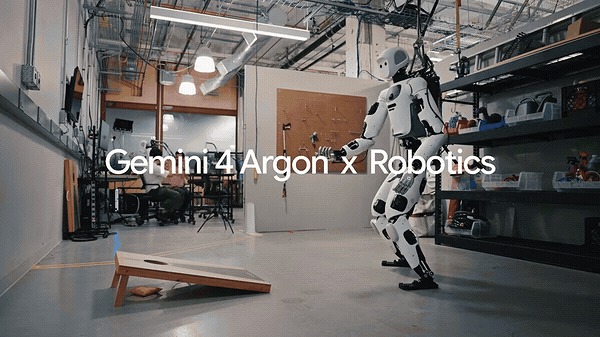
In its October 13 launch announcement, Google says Argon watched a human playing cornhole, mapped the scene and calculated whole-body joint movements. The resulting simulation work was transferred to Apollo, which made the seven shots in an internal physical trial. That establishes a reported demonstration, not a general success rate across unfamiliar throwing tasks.
The video can become an experiment specification
A recording supplies evidence about what happened. It does not automatically reveal what would happen with another release angle, a different object mass or a slower hand. A simulator makes those alternatives testable—provided its physics is credible. Automating its construction can therefore change the value of a video from one observed trajectory to a starting point for controlled interventions.
This is a more demanding use of visual understanding than naming objects or copying poses. The system must decide which features deserve physical representation. A decorative mark may be irrelevant; a small rim that catches a moving object may dominate the outcome. More faithful pixels do not necessarily improve the experiment.
Google’s robotics technical post makes this distinction unusually concrete. In a separate robot-view reconstruction workflow, its representative prompt requires both visual agreement and agreement with recorded fingertip forces. Geometry, mass, friction and joints can be tuned before the simulation begins. Moving objects by teleportation or copying recorded forces into the output is explicitly excluded.
Those restrictions matter because reproducing a movie and reproducing an interaction are different achievements. A scene can replay the right motion while encoding the wrong cause. Such a scene may fail immediately when asked to rehearse an action the original recording never contained.
A simulator can be convincingly wrong
Consider an illustrative throwing task in which an incorrect object mass is compensated by an incorrect release speed. The simulated object might land in the right place once. Change the target distance and the compensation can unravel. Agreement on one trajectory does not uniquely identify the physical parameters that produced it.
The next useful test would perturb a parameter the system has not already fitted: move the target, change the object, or start from a different posture. Then compare the simulator’s predicted change with the robot’s actual change. This would test whether the generated world explains the interaction well enough to support a new decision.
It would also be useful to report the work surrounding the seven-shot run: calibration, unsuccessful rehearsals, hardware-specific constraints and any human adjustments. Google’s headline result does not provide a distribution over those costs. They determine whether automatic simulation construction saves a robotics team an afternoon or merely relocates its debugging.
If models can build useful practice environments from ordinary video, teaching a new robot task could become less dependent on constructing every experiment by hand. The seven-shot trial does not yet establish that saving across tasks. It makes the next question clearer: how much calibration and correction is still needed before the generated world reliably predicts what the robot will do?
Questions, news tips or corrections? Contact [email protected].