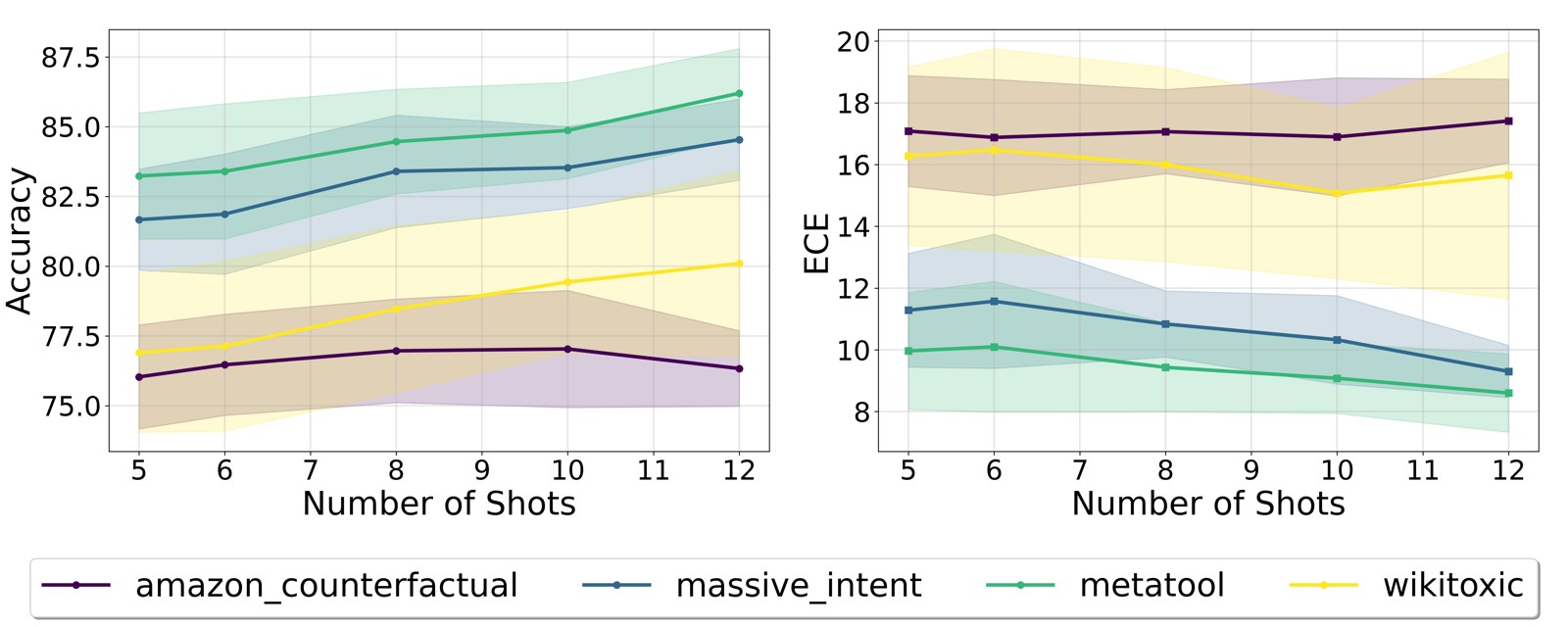
An example-filled prompt can make a model more accurate without making its confidence more trustworthy. The examples may tilt its expectations toward the classes they happen to represent.
CALIBFORMER, introduced October 12, uses predictions on demonstrations to calibrate a test prediction. Its authors train the calibrator across several models and tasks, then evaluate transfer to unseen ones. They report reduced calibration error, including on a frontier Gemini model. Read the research paper.
A better answer is not a better probability
Consider a defect classifier given mostly damaged components as demonstrations. It may learn the task while also exaggerating the likelihood of damage. That matters when a probability determines whether a production line stops.
The new work makes calibration a reusable component rather than a fresh fine-tuning exercise for every task. Transfer is the central claim to scrutinise. A held-out model is useful evidence; a new operational base rate or a genuinely unfamiliar class is a separate challenge.
Evaluate accuracy, confidence and abstention together under different demonstration mixes. A calibrator that fixes one selection bias may still inherit another from its own training distribution. Few-shot learning saves labelled examples, but it does not eliminate the need to check what those examples have taught the model to expect.
Questions, news tips or corrections? Contact [email protected].