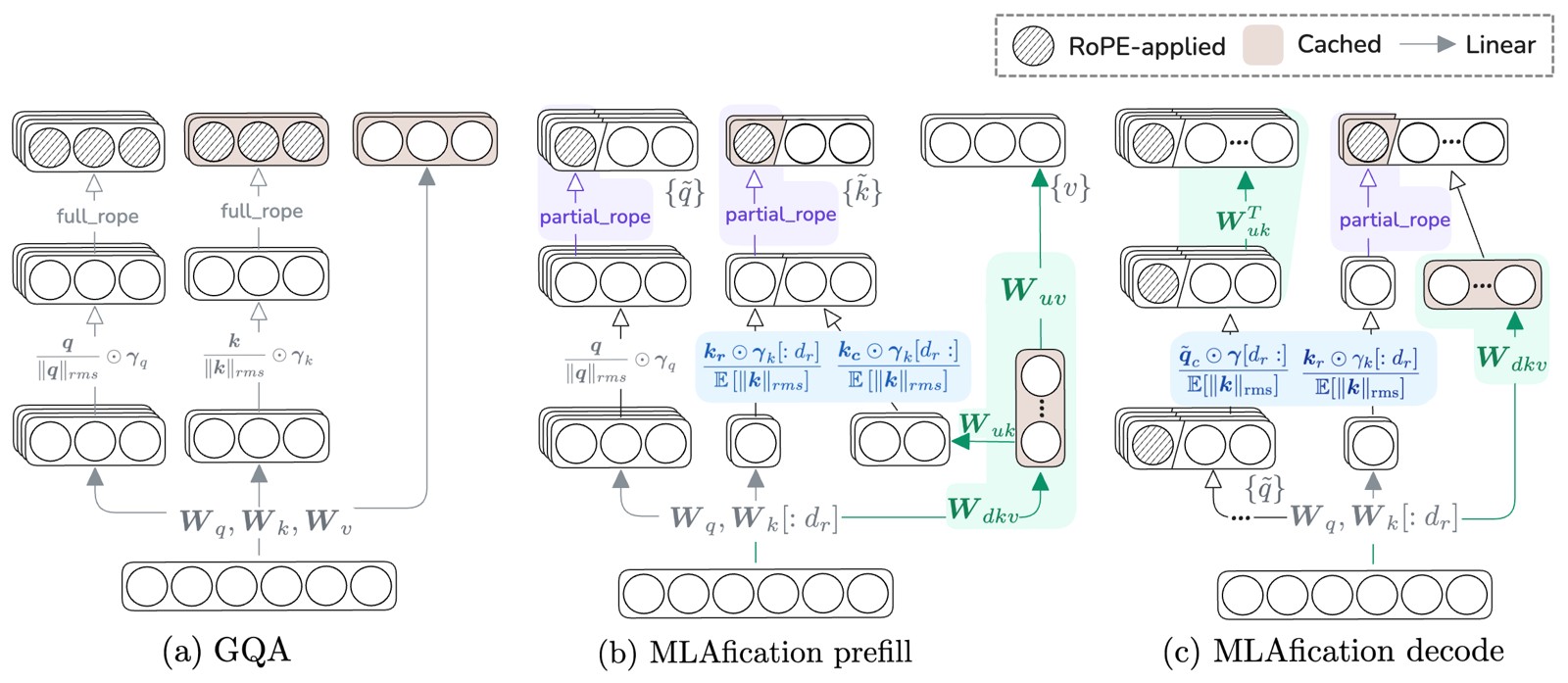
An expensive inference architecture is not always a permanent consequence of pretraining. MLAfication examines how to convert existing attention mechanisms while retaining the model's behaviour.
The October 12 paper extends multi-head latent attention conversion to models using query-key normalisation and mixture-of-experts components. Its recipe combines calibration, distillation and attention-specific initialisation; the authors report substantial cache savings on tested models. Read the research paper.
Retrofitting has a recovery bill
The useful comparison is not simply compressed versus uncompressed memory. Conversion changes how stored information is represented, so a model may need training to recover capabilities. That recovery has a cost, a dataset dependence and a possibility of uneven losses.
A serving team should compare the conversion bill against the expected lifetime of the deployment. A modest upfront adaptation can make sense for a frequently served model; a rapidly replaced checkpoint may never earn it back.
Long-context exceptions deserve particular attention. Preserving common-sense scores does not ensure that a compressed cache retains an unusual instruction many pages earlier. Test the questions your users actually ask at the context lengths they use.
MLAfication's contribution is a wider retrofit path, not a universal promise that any model can shrink without consequence. Architecture choice becomes a deployment decision that can be revisited after pretraining, provided the recovery and verification costs are counted.
Questions, news tips or corrections? Contact [email protected].