A driving model may recognise a cyclist, predict a plausible future and still select an unsuitable trajectory. Those are related capabilities, but success at one does not ensure success at the next.
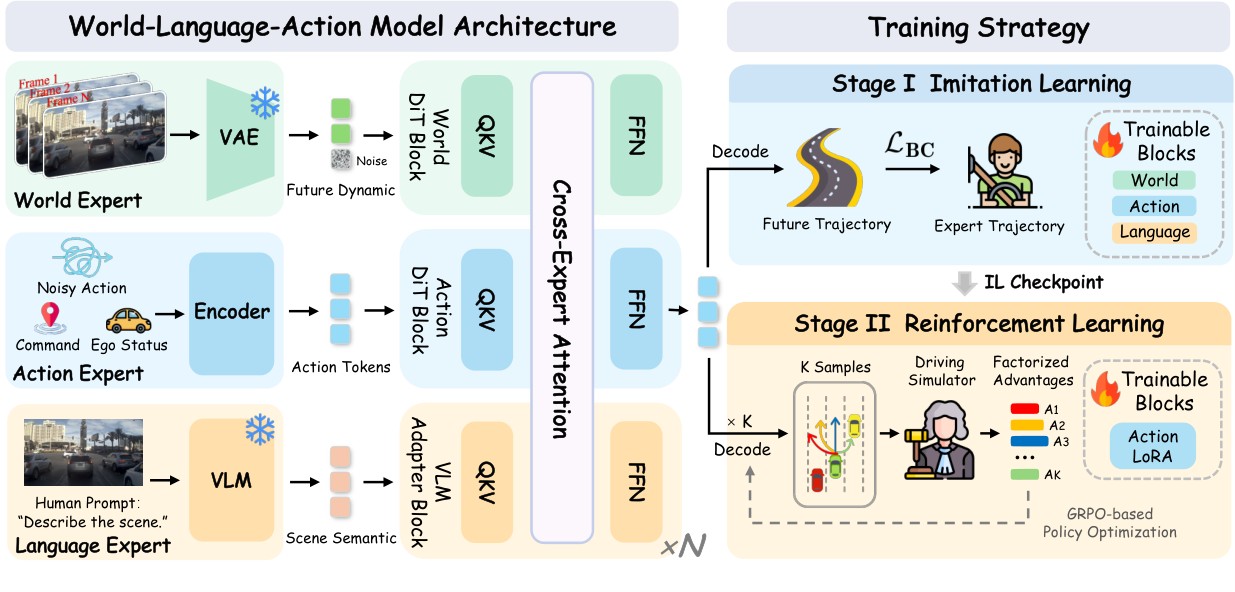
DriveWLA's October 13 paper uses world, language and action experts with cross-expert attention. Reinforcement-learning post-training then refines the action component. The authors report results on NAVSIM and transfer evaluations in additional driving environments. Read the research paper.
Agreement needs to affect the plan
The architectural question is what the trajectory generator receives from the other experts. A verbal hazard description is useful only if it changes the selected motion when the hazard changes. A predicted future is useful only if the action component treats it as evidence rather than decoration.
This calls for counterfactual testing. Hold the road layout fixed, alter the cyclist's movement, and examine whether semantic interpretation, predicted dynamics and trajectory change consistently.
Benchmark and simulated closed-loop performance should not be mistaken for a real-road safety validation. Distribution changes and sensing errors remain consequential.
DriveWLA makes information flow between capabilities an explicit part of the model. That is the practical story: improving driving intelligence may require a better interface between perception, forecasting and action, even when each component already performs well on its own test.
Questions, news tips or corrections? Contact [email protected].