Synthetic data are often described as abundant. For scientific simulators, producing each example can cost more than training on it.
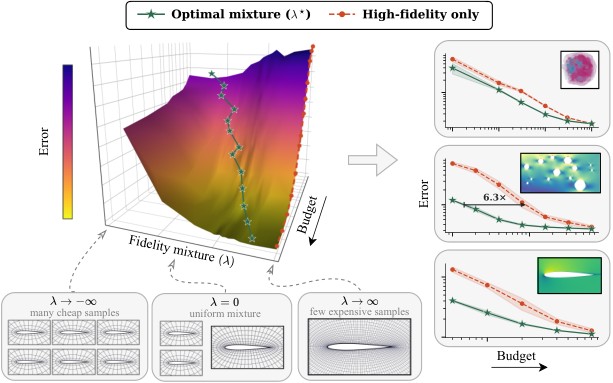
An October 12 study of neural PDE surrogates jointly optimises data quantity and numerical fidelity. Across its evaluated problems and architectures, mixing lower- and higher-fidelity simulations matches high-fidelity-only accuracy with less data-generation compute. Read the research paper.
Spend accuracy where it changes learning
One highly precise solution is not always worth several cheaper examples covering different conditions. But low-fidelity errors are structured, so indiscriminately adding inexpensive simulations can teach a systematic bias.
The study exploits known relationships between numerical fidelity and error. That grounding matters. A visually plausible generative simulator may not offer an equivalent convergence guarantee.
For a scientific learning pipeline, include data generation in the compute ledger and vary fidelity explicitly. Compare mixtures under a fixed total budget, including validation against accurate solutions.
The result reframes “high-quality data.” Quality is not simply the precision of each sample; it is the usefulness of the entire collection for the target error budget. A deliberately uneven dataset can be more informative than an equally expensive collection in which every example is polished to the same standard.
References
Questions, news tips or corrections? Contact [email protected].