A larger skill library should make an agent more capable. It can instead make the relevant skill harder to load, even when that skill has not changed.
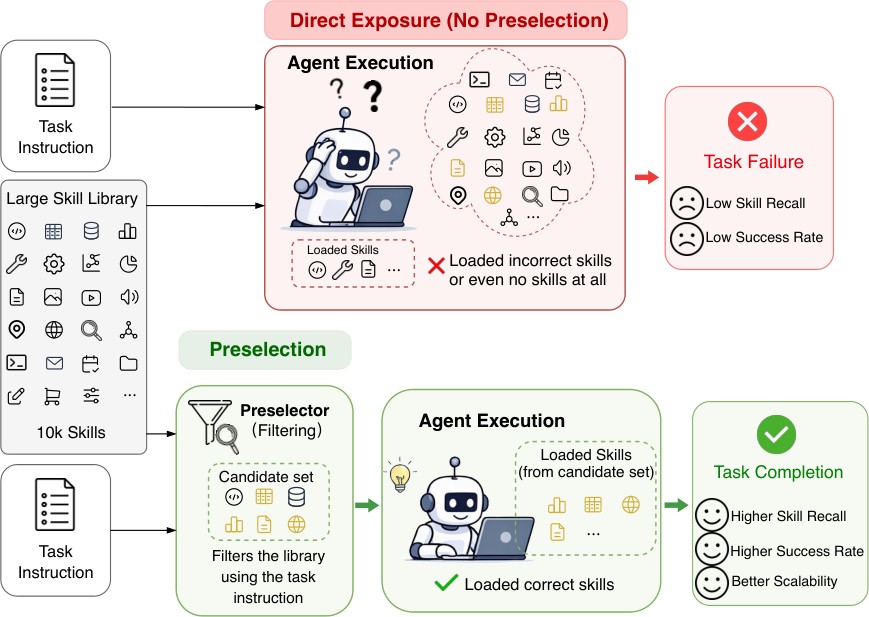
An October 13 study keeps tasks and golden skills fixed while adding irrelevant skills. Implicit routing deteriorates; explicit preselection performs better. Masking irrelevant descriptions restores much of the loading behaviour in the authors' tests. Read the research paper.
More available knowledge can mean less usable knowledge
The failure is not simply choosing the wrong alternative. Agents increasingly load no skill. Descriptions and execution instructions compete for attention, so availability does not ensure access.
Preselection adds its own latency and coverage risks. A selector can miss a useful but unfamiliar skill, so compare full-task success as well as recall of the expected one.
For evolving agents, test library growth while holding tasks fixed. That isolates interference from genuine changes in task difficulty.
The finding matters for self-learning systems whose progress is stored as new procedures. A growing archive can undermine execution unless retrieval and routing scale with it. Accumulating skills is only useful when the agent continues to recognise the moment to use them.
References
Questions, news tips or corrections? Contact [email protected].