An example can be too hard to teach anything useful, become productive after some training, then become redundant. Its value is a relationship with the student, not a fixed quality label.
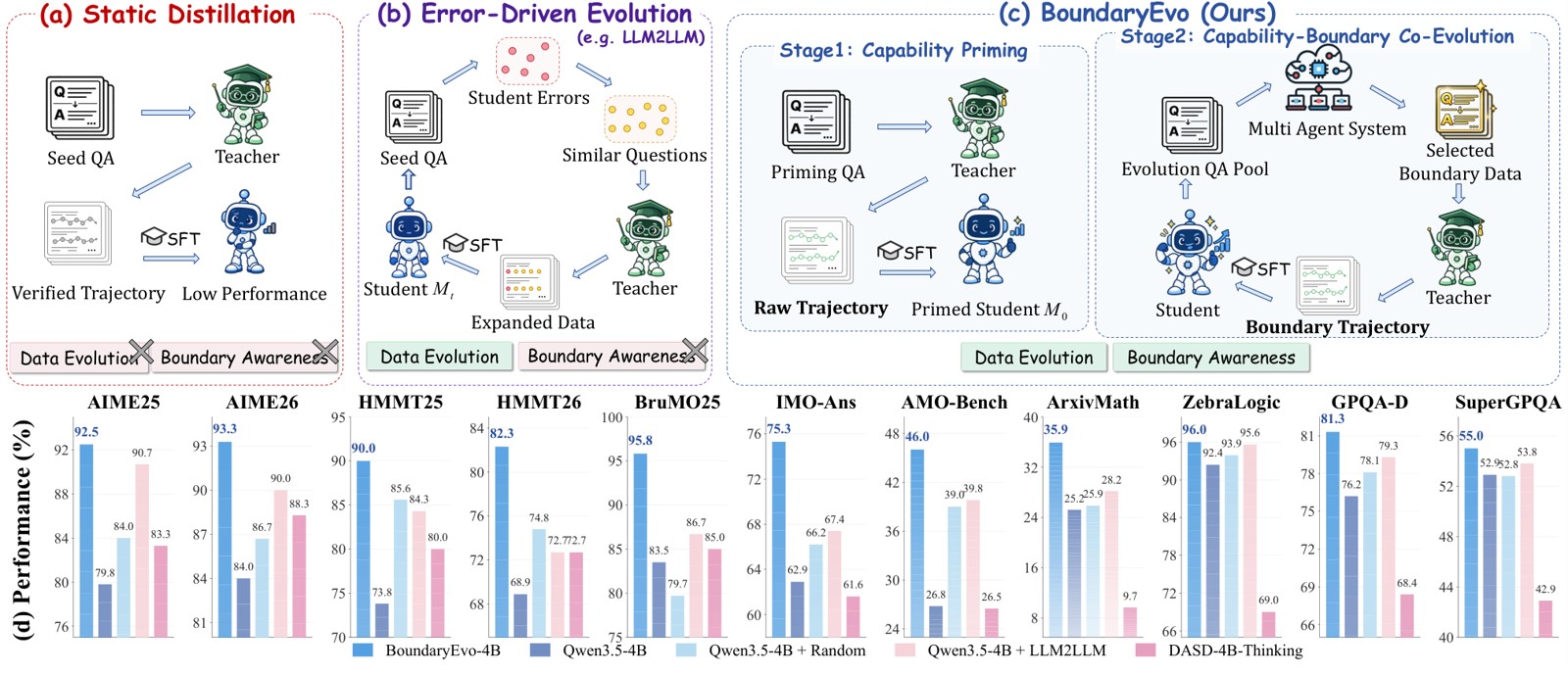
BoundaryEvo, posted October 9, first primes a small model with teacher trajectories, then repeatedly selects questions the student has not mastered but the teacher can reliably solve. The authors report gains across their reasoning evaluations with a limited training set. Read the research paper.
The first stage makes later selection possible
A weak student may provide noisy signals about what it can learn. Priming gives the adaptive selector a more meaningful boundary to follow. This explains why simply starting with the hardest examples is not equivalent to an evolving curriculum.
Teacher reliability also matters. A question beyond the student is useful only if its demonstration is sound and understandable enough to learn from.
Evaluate total teacher-generation cost, including rejected examples, when comparing data efficiency. A small final dataset can conceal a large search pipeline.
The result supports updating the curriculum with the learner. It does not mean that every unmastered question belongs in training. The productive zone lies between material already absorbed and material for which the available supervision still cannot bridge the gap.
Questions, news tips or corrections? Contact [email protected].