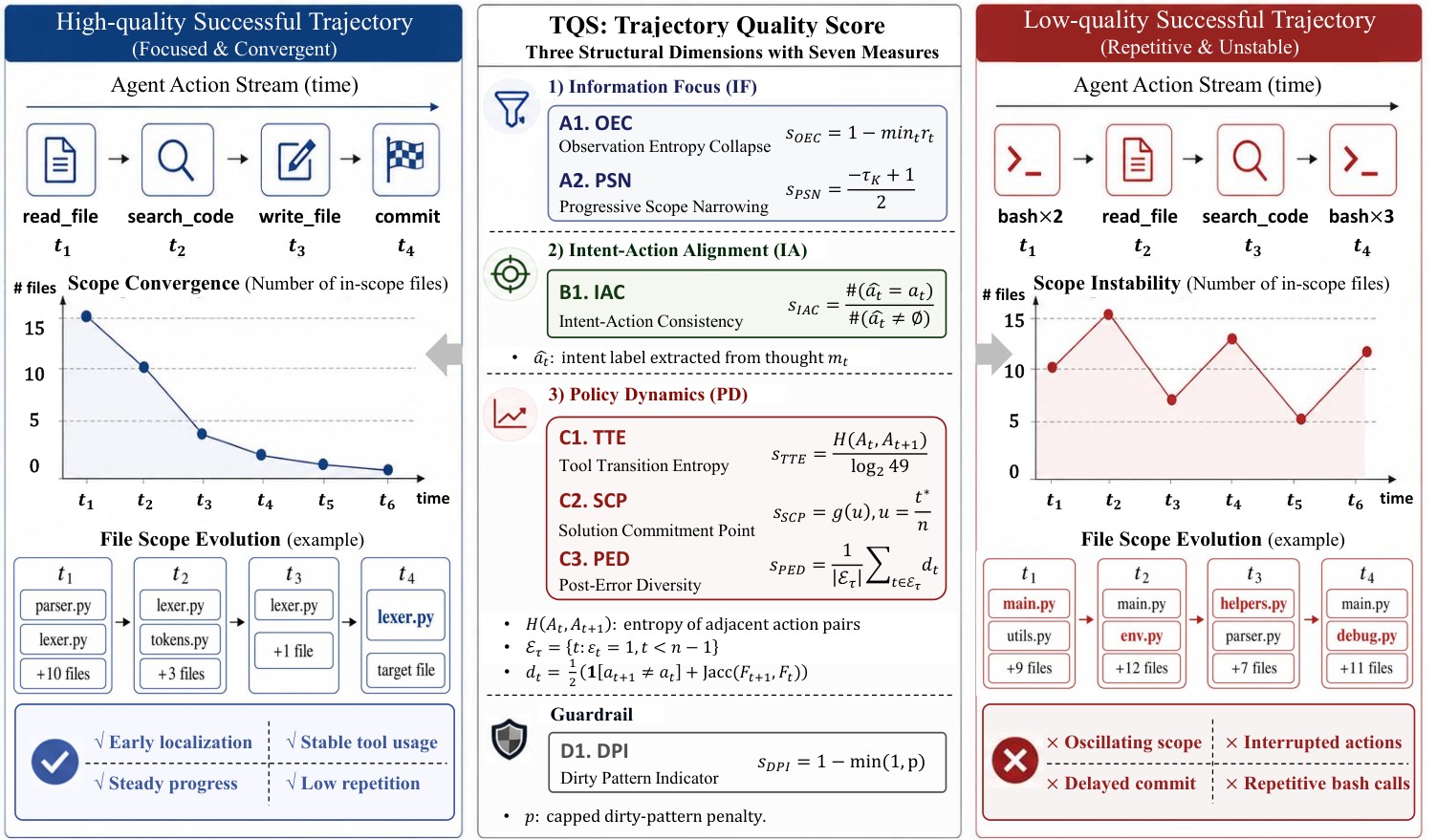
A coding agent may eventually repair a bug after repeated file reads, confused tool calls and several abandoned edits. Training on the whole successful trace teaches those habits alongside the repair.
The October 9 TQS paper scores process structure in successful coding trajectories without an LLM judge. Its authors report that selecting higher-ranked traces improves fine-tuned agents relative to random or lower-ranked selections. Read the research paper.
Success is a filter, not a complete quality measure
Outcome filtering answers whether the final artifact worked on a test suite. It does not identify which earlier behaviour deserves imitation. A slow path can contain both essential investigation and pointless repetition.
Structural scoring introduces its own bias. A concise-looking trajectory may skip verification, while a legitimately difficult repair may need revisiting evidence. Check whether gains hold across task complexity, rather than assuming shorter or smoother is always better.
The paper's findings concern its corpus and evaluated agents. They do not establish a universal process score for software work.
The useful editorial point is that agent-training data contain behaviour, not just answers. Selecting the right final patch and selecting the right way to reach it are different curation problems. Improving one while ignoring the other can preserve the very inefficiency a new model was meant to remove.
Questions, news tips or corrections? Contact [email protected].