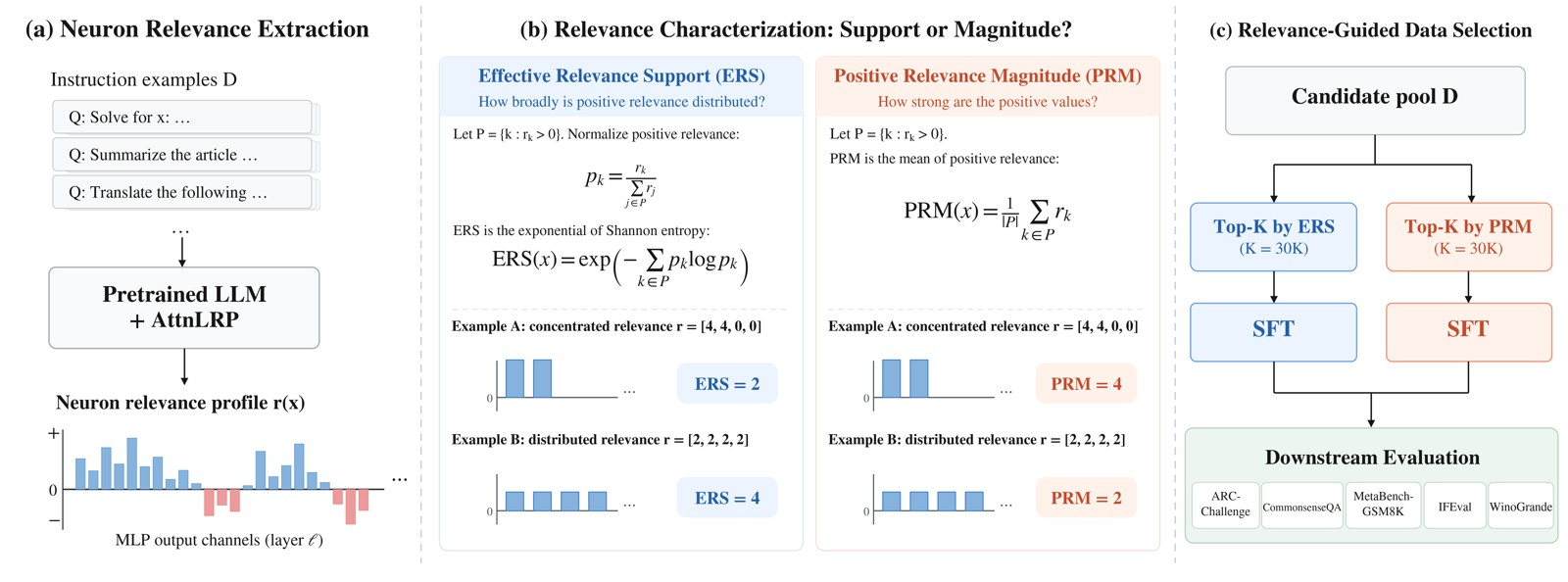
An instruction can strongly engage a narrow set of model features. Another can spread useful computation across many features. A selection method that measures only strength treats that difference as irrelevant.
An October 12 paper compares effective relevance support with positive relevance magnitude using attribution profiles. The criteria rank examples differently, and support-based selection performs well across the authors' evaluated models and benchmarks. Read the research paper.
Internal activity has more than one dimension
The finding cautions against calling a sample important merely because it produces a large internal signal. Magnitude can reflect intensity without breadth; breadth can reflect useful coverage without a dramatic peak.
Neither interpretation is automatically causal. Attribution describes a model under a particular computation. The real test is whether training on the selected examples improves held-out behaviour.
Backbone dependence also matters. A ranking built from one model's features may not identify the same lessons for another. Inspect transfer instead of assuming neuron-level sophistication makes the selector universal.
For dataset curation, preserve the distinction between a measurement and its interpretation. The paper's contribution is to show that even with the same underlying relevance profile, the aggregation choice changes what the training pipeline considers worth learning.
Questions, news tips or corrections? Contact [email protected].