Making a transformer deeper usually means buying more parameters as well as more computation. Tab-Loop asks whether tabular in-context learning needs both purchases.
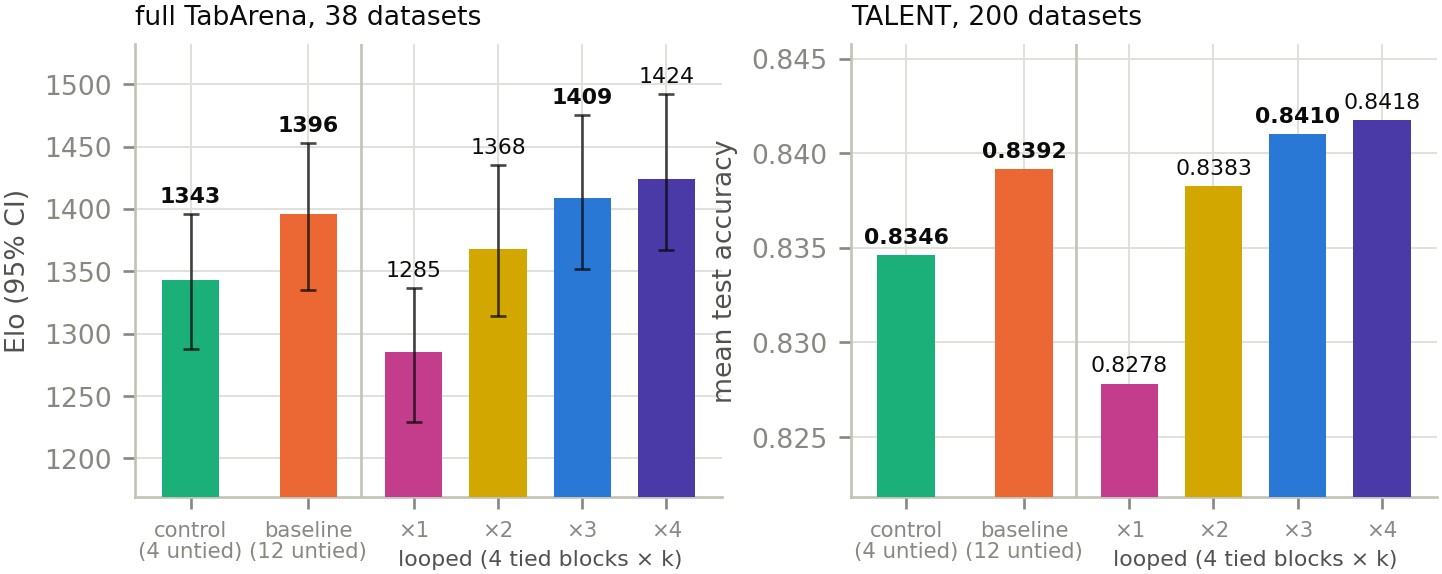
The October 10 paper replaces twelve distinct blocks with four shared blocks applied repeatedly. Under matched training and inference compute, the authors report similar tabular performance with fewer parameters. A shallow, untied control does worse. Read the research paper.
Smaller does not necessarily mean shallower
The control is the revealing comparison. It suggests that repeated transformation matters more than owning a separate parameter set for every transformation in this setting. Parameter count alone would miss the distinction.
Shared weights also turn depth into a serving choice. An operator can spend extra loops on a difficult query without loading another set of weights. The price remains computation and latency; a small model that loops extensively is not automatically cheap to run.
The paper's tabular benchmarks do not establish the same trade-off for every language or robotics task. Nor do gains from additional loops imply unlimited improvement. Inspect where performance saturates and whether some datasets deteriorate.
For resource-constrained applications, the result opens a useful design space: keep the resident model compact while varying how long it works. Memory capacity and reasoning effort can then be budgeted separately instead of being bundled into a single model-size decision.
Questions, news tips or corrections? Contact [email protected].