Researchers can decode depth or spatial structure from a model's internal features and still find that those features do nothing for its answers.
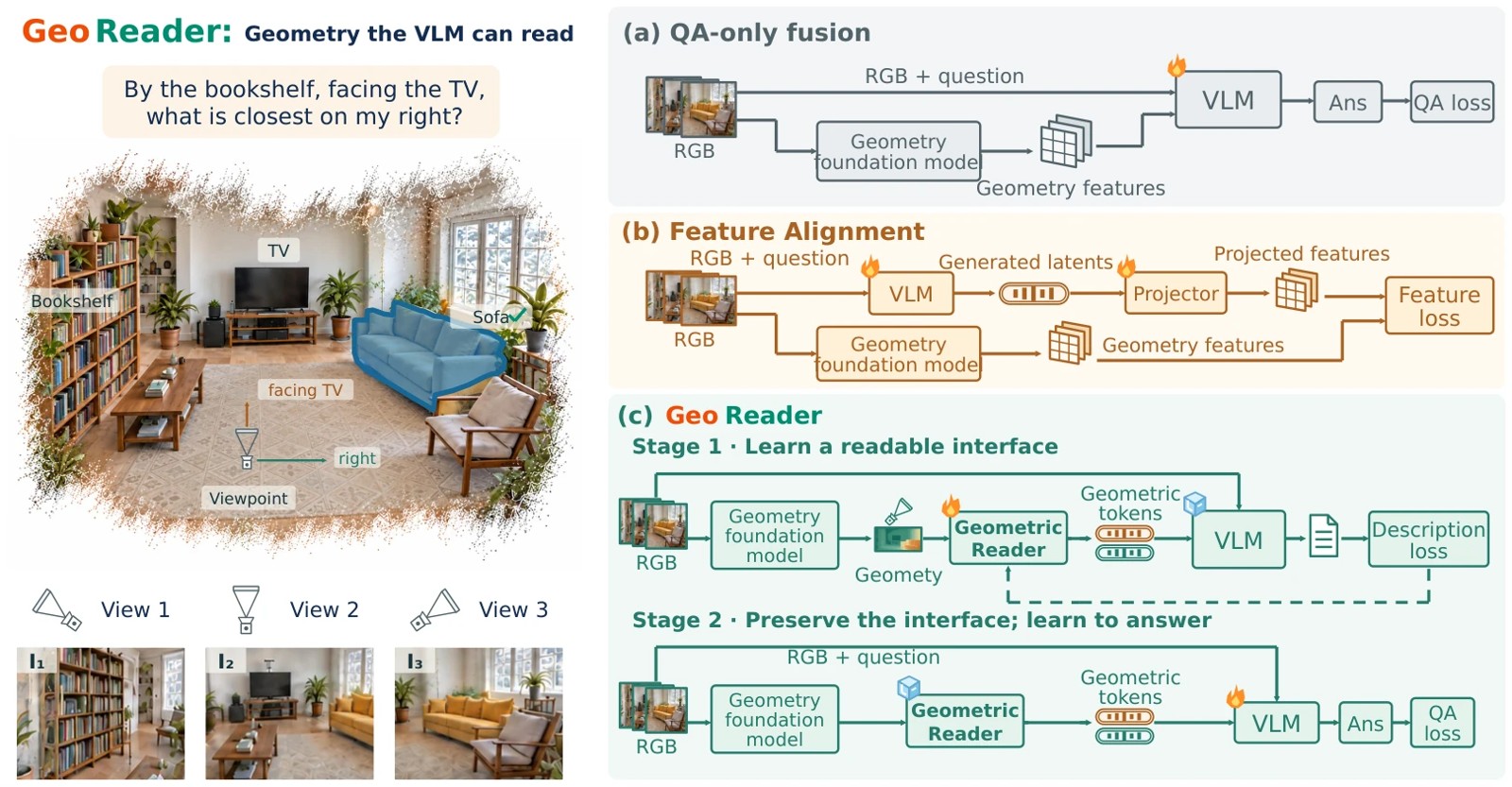
GeoReader's October 13 paper reports a striking intervention: zeroing aligned geometric latents in a released comparison model leaves accuracy unchanged. Its alternative trains lightweight readers to express geometry in a form a frozen language model can interpret, then preserves that interface during spatial question-answering training. Read the research paper.
Decodable information is not causal evidence
An external probe demonstrates that information is present. Removing the information tests whether the system depends on it. Confusing those tests can make an apparently sophisticated representation look more useful than it is.
GeoReader's design turns the receiving model into part of representation training. The objective is not simply to estimate geometry correctly, but to communicate it effectively.
Deployment verification should retain the intervention. Compare answers with real geometry, shuffled geometry and no geometry, particularly on questions requiring metric or multi-view evidence. A gain that survives shuffling may come from an unrelated training effect.
The reported benchmark improvements support this interface-focused approach. They do not settle every spatial task. The insight is broadly useful: a better sensor representation only becomes a better reasoning system when the decision process actually reads it.
References
Questions, news tips or corrections? Contact [email protected].