Who put the object back? Was it returned to exactly the same place? Did someone straighten the cable after the previous failure?
Those questions rarely appear beside a robot’s headline success rate. They can determine which task the next trial actually presents.
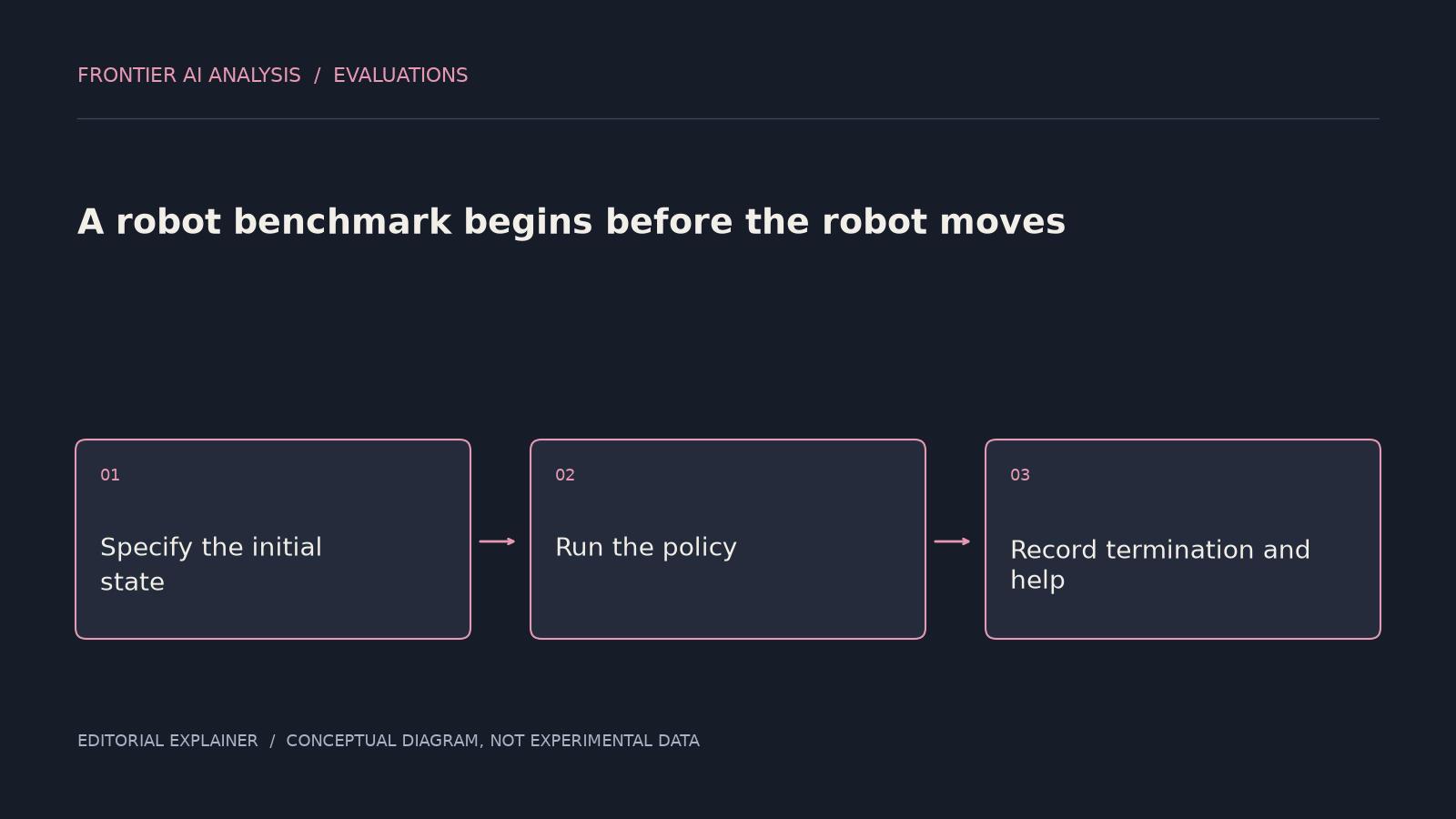
The October 5 Inspect Robots paper describes a modular framework for specifying physical evaluations and analysing their results, with infrastructure to automate setup, execution and termination. The authors demonstrate it with six policies based on frontier language models. This is a paper about a framework already released earlier, rather than an October 5 product debut.
The analytical opportunity lies in treating the surrounding procedure as part of the experiment. A policy score is produced by the model and by the conditions under which the model was allowed to operate.
Resetting can make a task easier
Consider a hypothetical manipulation test in which a human returns every object to a neat arrangement. The evaluation may measure the ability to work from neat arrangements very well. It says less about a robot that must recover after leaving the scene disordered itself.
That is not cheating if the starting-state rule is explicit. It becomes misleading when the score is interpreted as evidence of sustained operation. The reset has removed a class of states that the deployed system may need to handle.
Termination rules can have a similar effect. A trial stopped after a fixed time differs from one allowed repeated retries. If a human intervenes before damage or a fall, the record should distinguish a prevented failure from an autonomous recovery. Otherwise two labs can use the same task name while measuring different capabilities.
Make the help visible
Automation can improve repeatability, but it does not automatically make a test representative. An automated reset can impose a narrow state distribution just as consistently as a careful human can. The important benefit is the ability to specify and inspect that procedure.
A useful evaluation record would include the initial state, the policy version, the termination reason and every intervention. It would distinguish assistance used to run the experiment from assistance required by the policy to finish the task. The latter belongs in any account of autonomy.
For sustained-operation claims, one could add sequences in which the next trial inherits the previous trial’s physical aftermath. Comparing that setting with clean resets would reveal how much performance depends on restoring the world between attempts. This is a proposed extension of the evaluation logic, not a result established by the paper.
The most revealing benchmark improvement may therefore be less glamorous than a new task. It may be a complete record of how each trial began and why it ended. A robot’s behaviour becomes easier to compare when the invisible work around it is no longer invisible.
References
Questions, news tips or corrections? Contact [email protected].