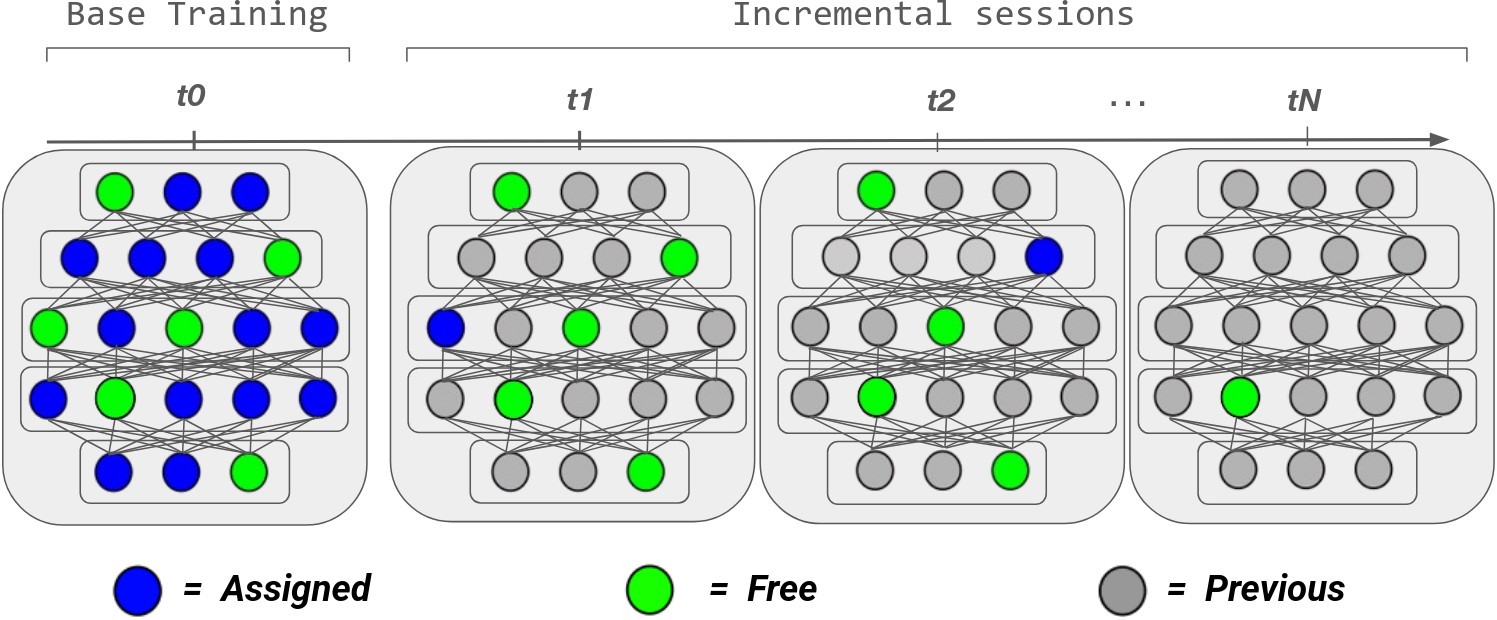
Freezing old knowledge protects it, but can leave too little flexibility for new classes. Updating everything restores flexibility while risking the knowledge already acquired.
An October 2 paper proposes Selective Backpropagation, which restricts updates to pre-allocated parameter subsets. It evaluates few-shot incremental learning beyond short, familiar benchmarks, including cross-domain settings and a longer ImageNet stream. Read the research paper.
The learning horizon changes the trade-off
A strategy that works for a few sessions can exhaust its reserved capacity or accumulate interference over many more. Short evaluation may therefore reward a design whose failure has merely been postponed.
Pre-allocation avoids expensive mask optimisation, but it assumes something about future demand. Unequal task difficulty could leave one region constrained while another remains underused.
Track per-session acquisition, retention and remaining adaptable capacity. An aggregate final score does not reveal whether later tasks become progressively harder to absorb.
The paper's broader evaluation is as important as its update rule. Continual learning means preserving a useful system through a stream, not demonstrating a few successful additions. Efficiency claims need to survive the length and distribution changes that make ongoing learning operationally different from ordinary fine-tuning.
References
Questions, news tips or corrections? Contact [email protected].