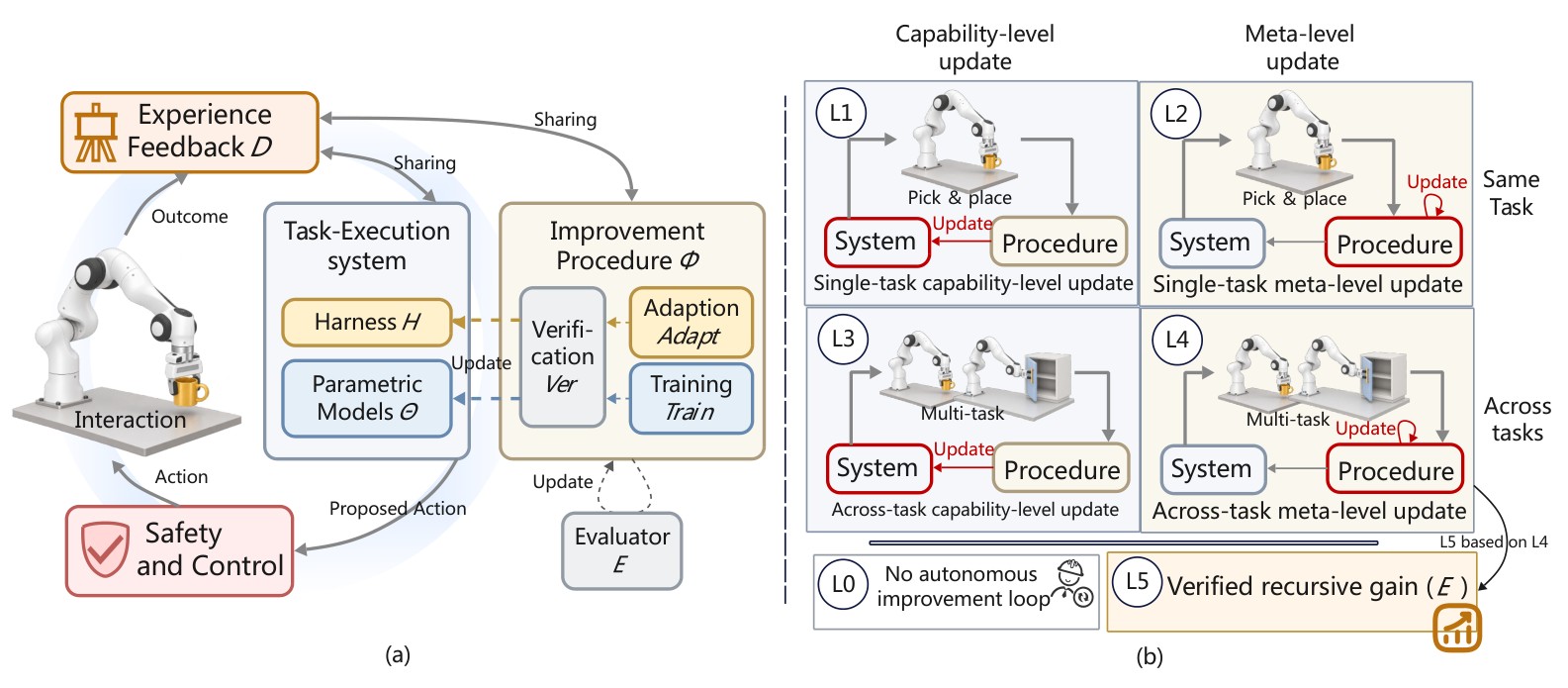
A robot can become better at stacking blocks after practice. Recursive improvement makes a stronger claim: the experience should improve how it learns the next task as well.
An October 13 physical-RSI survey distinguishes capability updates, meta-level updates and transfer across tasks. Under its proposed framework, the surveyed literature does not yet demonstrate independently verified physical recursive self-improvement at the highest level. Read the research paper.
Count the work needed for the next improvement
A useful test compares learning campaigns, not just final policies. Does the improved robot require fewer trials, less human intervention or better experiment selection on a new task?
Physical trials introduce noisy observations, hardware changes and irreversible consequences. A faster improvement loop may simply be taking more risks or receiving more hidden assistance.
The framework's levels are an analytical proposal rather than an accepted universal standard. Their value is making claims separable and measurable.
For coverage of physical AI, this distinction prevents an impressive demonstration from becoming evidence for an entirely different phenomenon. Better task execution is progress. Better learning efficiency across tasks is additional progress that needs its own measurement. A recursive claim should identify the retained change that makes subsequent improvement more effective.
Questions, news tips or corrections? Contact [email protected].