One global training schedule assumes that every example becomes ready for reward-driven refinement at the same time. That is unlikely in a small, unevenly supervised domain dataset.
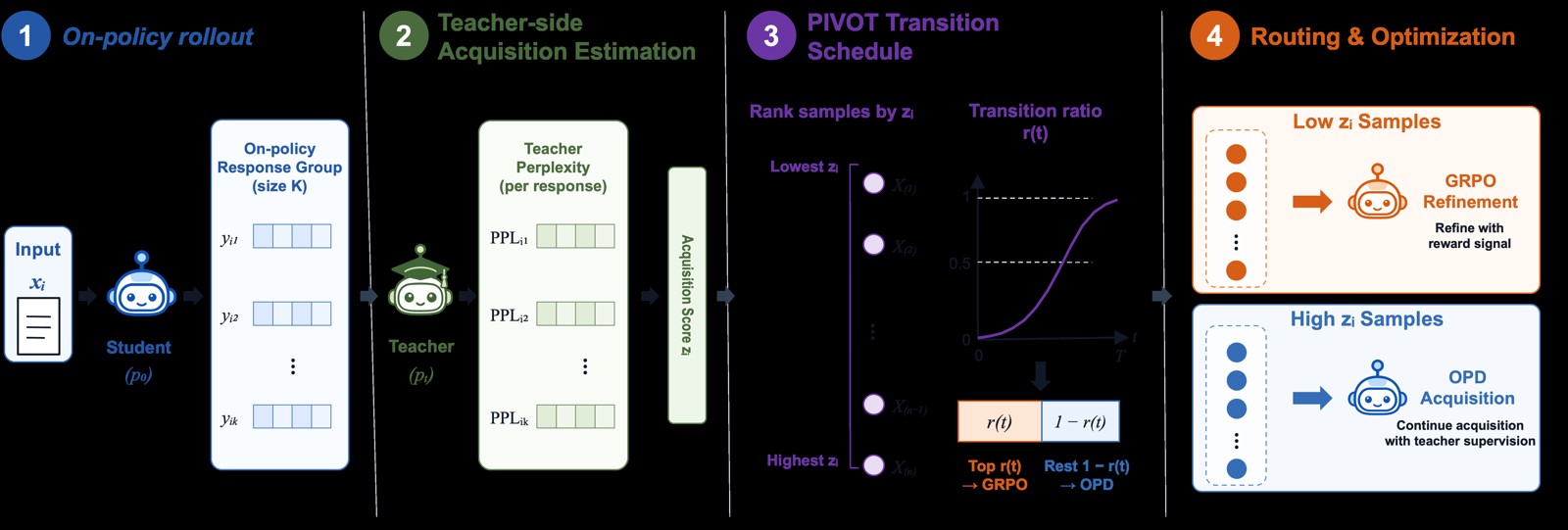
PIVOT's October 8 paper uses teacher-evaluated perplexity to route samples between on-policy distillation and GRPO. Lower-perplexity samples move toward reward-based refinement while others remain under teacher guidance. The authors evaluate the method on two intent-classification datasets. Read the research paper.
The transition is a sample-level decision
The mechanism distinguishes acquiring basic domain knowledge from refining an already meaningful prediction. Switching too early can leave a student chasing sparse rewards before it has learned the relevant concepts.
Perplexity is still a proxy. A teacher can assign low perplexity to a fluent but shallow response. Check whether routing tracks actual competence, especially for rare classes and misleadingly familiar language.
Matched optimisation steps do not necessarily mean matched total cost. Teacher scoring and different supervision paths should appear in the compute comparison.
PIVOT's results are a targeted few-shot finding, not a universal scheduling rule. They suggest that training phases can coexist within one dataset. Some lessons need more explanation while others are ready for practice, even when both arrive in the same batch.
Questions, news tips or corrections? Contact [email protected].