A rounding error in a feed-forward layer affects later layers once. Reusing a transformer block can send the consequences back through the same computation repeatedly.
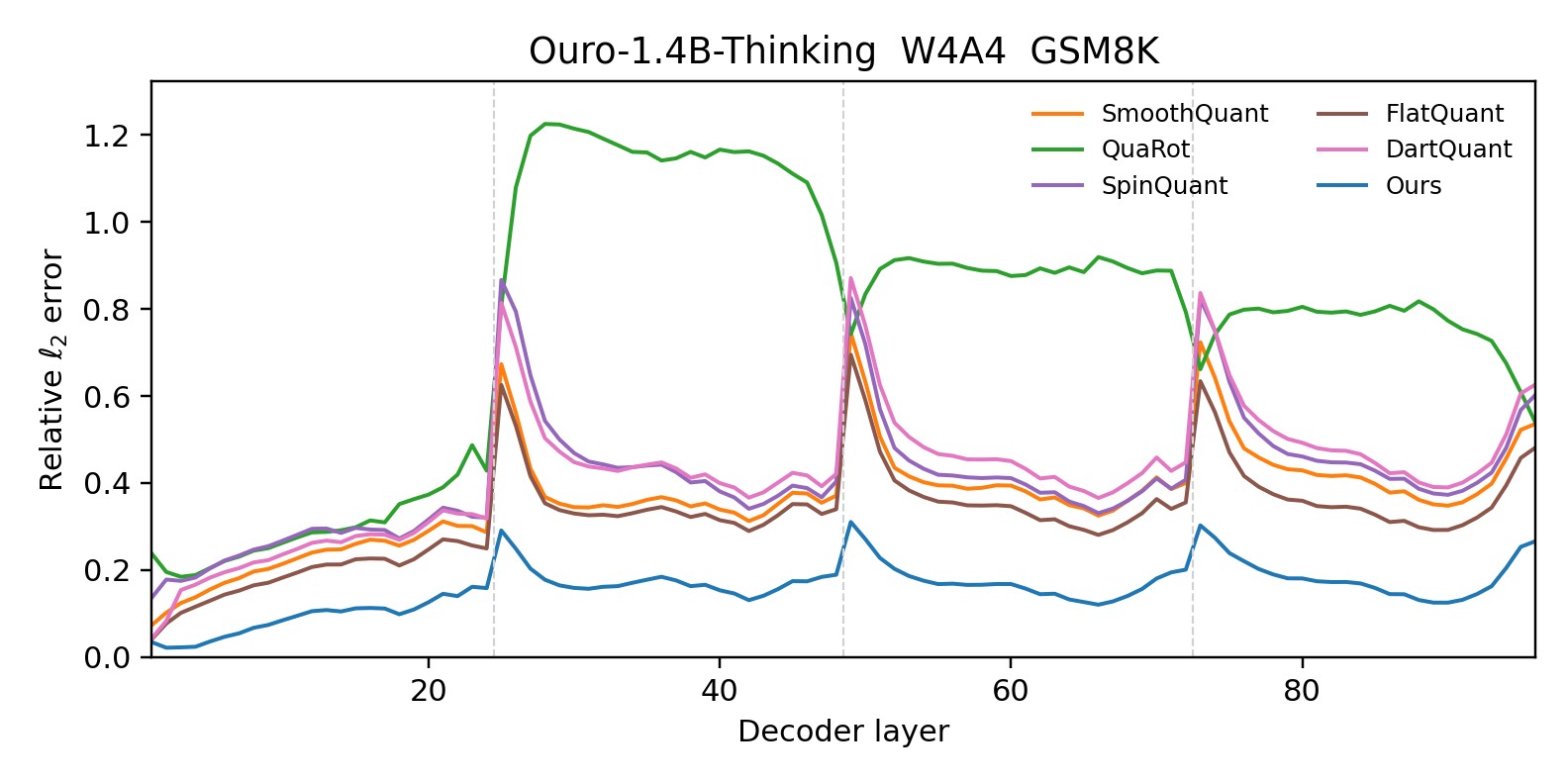
LoopQuant's October 12 paper studies this problem in looped language models. It combines cross-loop representation calibration, loop-sensitive precision allocation and task calibration, with reported quality and serving improvements over evaluated quantisation baselines. Read the research paper.
Shared weights do not imply identical activation needs
The same parameters encounter different recurrent states on successive loops. A quantisation rule calibrated only to one state distribution can therefore be poorly matched to later execution.
Precision allocation should also account for interactions. An error tolerated in an early loop may become important after repeated transformation, while another loop can be compressed more aggressively.
Compare performance over the deployment's loop counts, including counts beyond the most common training setting. A single fixed-depth result can hide instability when users request more computation.
LoopQuant reinforces a broader distinction: parameter efficiency and numerical robustness are separate design problems. Sharing a small set of weights reduces storage, but serving those weights at low precision requires understanding the changing states they process.
Questions, news tips or corrections? Contact [email protected].