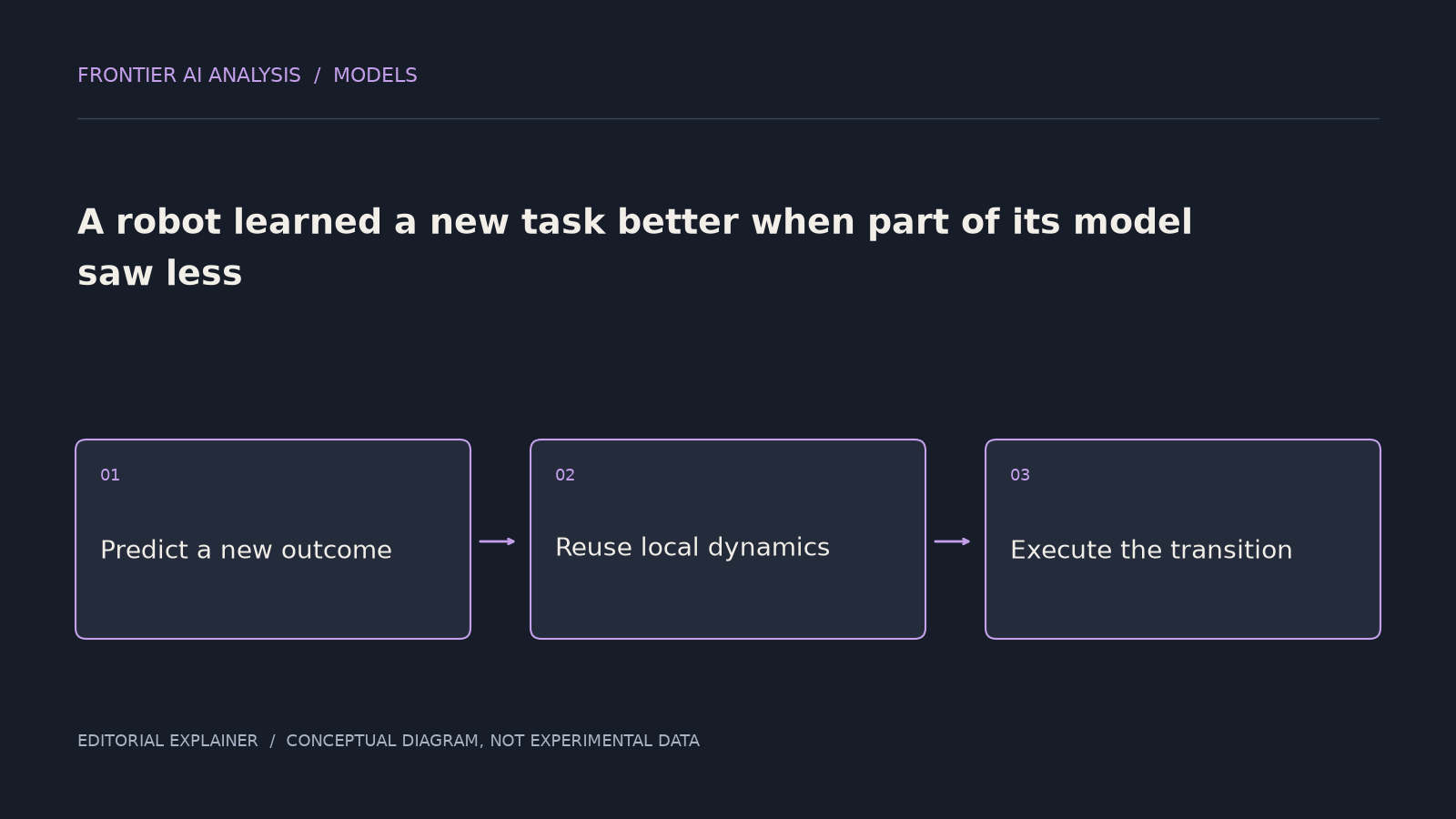
More context usually sounds like a gift to a model. In one OpenWAM experiment, the less-informed component transferred better.
The October 6 paper reports 84 percent mean success on four held-out LIBERO-90 tasks when a frozen, local-context inverse dynamics model is paired with a video predictor adapted to the new task. A full-context inverse model reaches 47 percent. The local model trained on demonstrations alone reaches 21.5 percent; the stronger version also receives counterfactual transitions.
These are tightly scoped comparisons, not proof that smaller context is universally better. The project and code predate the paper. What makes the result interesting is the separation of jobs: one component predicts what should happen; another works out how to produce a local transition.
A useful specialist should forget some things
An inverse dynamics model maps a desired change in state to an action. In principle, the physical relationship between a small movement and its result can be reusable across tasks. In practice, a model exposed to the whole task can learn associations that work only inside the training routine.
Imagine a controller that learns to move left because the current scene resembles the opening of a familiar sorting sequence. It may succeed without learning the more portable relationship between displacement and action. A local transition model has less opportunity to rely on that story.
The counterfactual training comparison is therefore essential. Removing context by itself did not produce the strong result. The experiment also changes what transitions the model learns from. Alternative outcomes can help break the association between a familiar situation and the one action that happened to appear in a successful demonstration.
Modularity must earn its keep
For builders, the finding raises a practical architectural question: which knowledge should move when a task changes? If a reusable motor component can remain fixed, a new task might require changing the predictor rather than relearning the entire relationship between observation and action.
That division could reduce adaptation work, but it creates an interface to police. A predictor may request a transition outside the frozen controller’s abilities. Good-looking future video would then be an aspiration rather than an executable plan. The relevant test would ask whether predicted transitions remain inside the controller’s demonstrated operating range.
It would also be useful to separate two sources of improvement: resistance to scene shortcuts and the quality of the counterfactual examples. The reported ablations motivate that investigation; they do not settle every causal detail.
The result offers a counterweight to the instinct to give every component everything. A planner may need the task’s full meaning. The part responsible for a small physical transition may become more useful precisely because it is less entangled with that meaning. The right context budget depends on the job a component is supposed to keep when the rest of the task changes.
References
Questions, news tips or corrections? Contact [email protected].