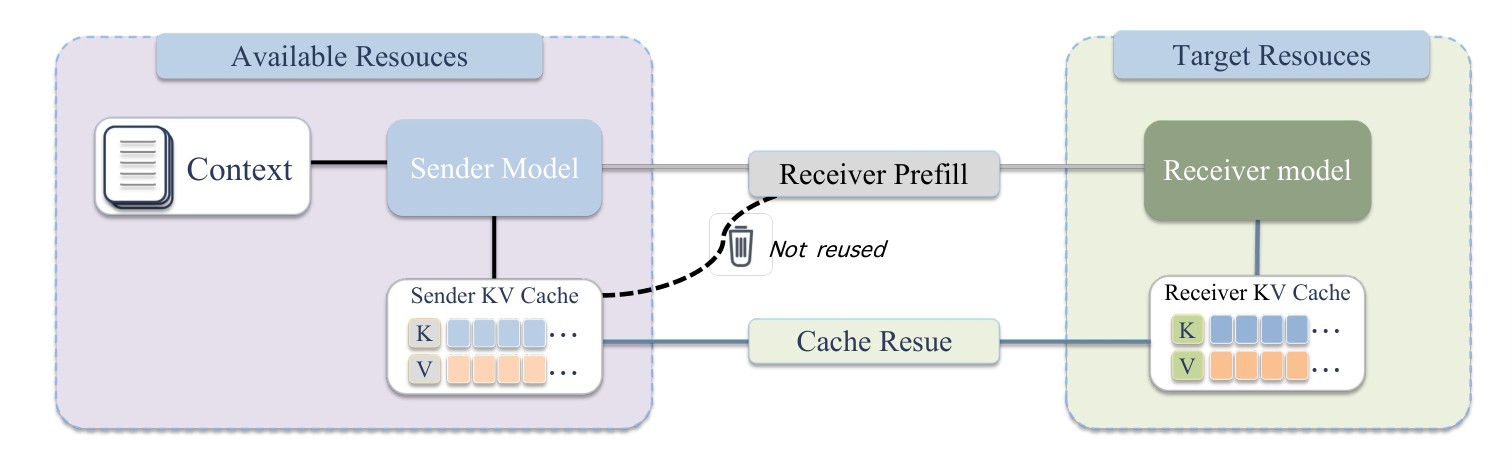
Switching to another model normally means processing the context again. Translating the first model's cache could avoid that cost, but matching stored numbers is not enough.
CacheLink's October 11 paper finds that similar key-value reconstruction errors can produce different attention and answers. Its correction objective targets the receiving model's behaviour, improving evaluated handoffs between independently trained model pairs. Read the research paper.
The receiver defines what must survive
A small error in an important attention direction can matter more than a larger error in an unused one. Numerical similarity averages those differences away.
This is especially relevant to systems that escalate from a cheap model to a stronger one. The stronger model should inherit evidence, not merely an internal state that resembles its own under an incomplete metric.
Test exact-answer preservation, instruction handling and uncommon context details against fresh receiver prefill. Include the cost of learning a transport for each supported pair.
The reported latency gains establish an opportunity in the evaluated settings, not unrestricted model interchangeability. CacheLink's central lesson is broader: compatibility is functional. A handoff succeeds when the receiving computation remains useful, even if a conventional reconstruction score barely changes.
References
Questions, news tips or corrections? Contact [email protected].