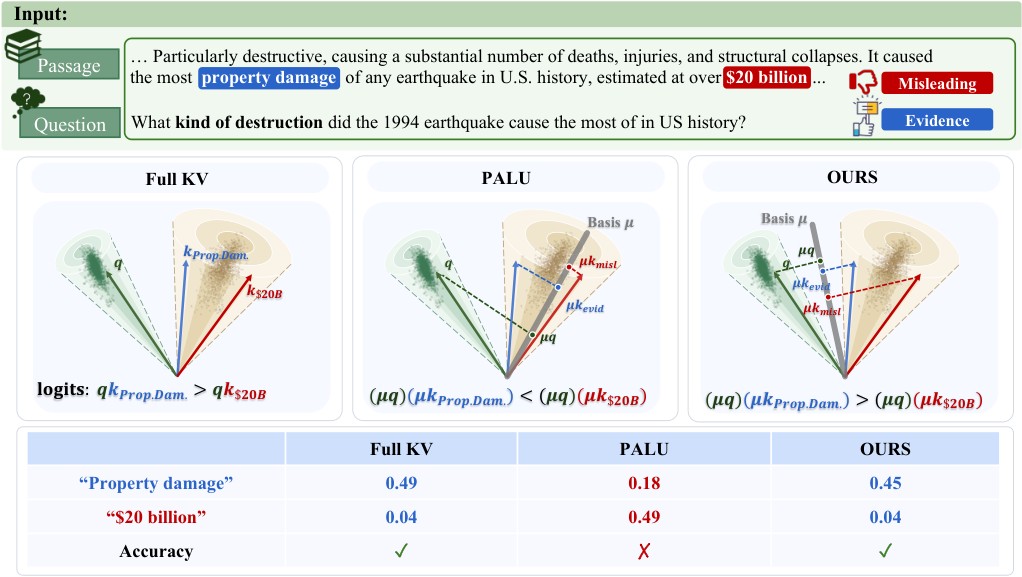
Two compressed keys can be numerically close to the originals and still change which passage a model attends to. Reconstruction error is not the same as preserved computation.
BELT's October 13 paper targets attention distributions in its low-rank objective and learns how to allocate rank under a component budget. The authors report quality and throughput gains on their evaluated language models. Read the research paper.
Spend rank on functional differences
Uniform compression assumes each component deserves the same share of memory. A behaviour-aware allocation instead asks where reduced precision or rank changes a consequential decision.
The benefit remains workload-dependent. A component rarely used in calibration can become important for an unusual user query. Test rare evidence retrieval and instruction conflicts alongside average benchmark performance.
Kernel support matters too. A mathematically smaller cache can create awkward data layouts or extra operations. BELT includes GPU implementation results; those should be compared on the target serving stack rather than transferred by ratio alone.
The paper adds a useful criterion to the memory-efficiency debate. The goal is not to reproduce every stored number accurately. It is to preserve the distinctions those numbers allow the model to make.
Questions, news tips or corrections? Contact [email protected].