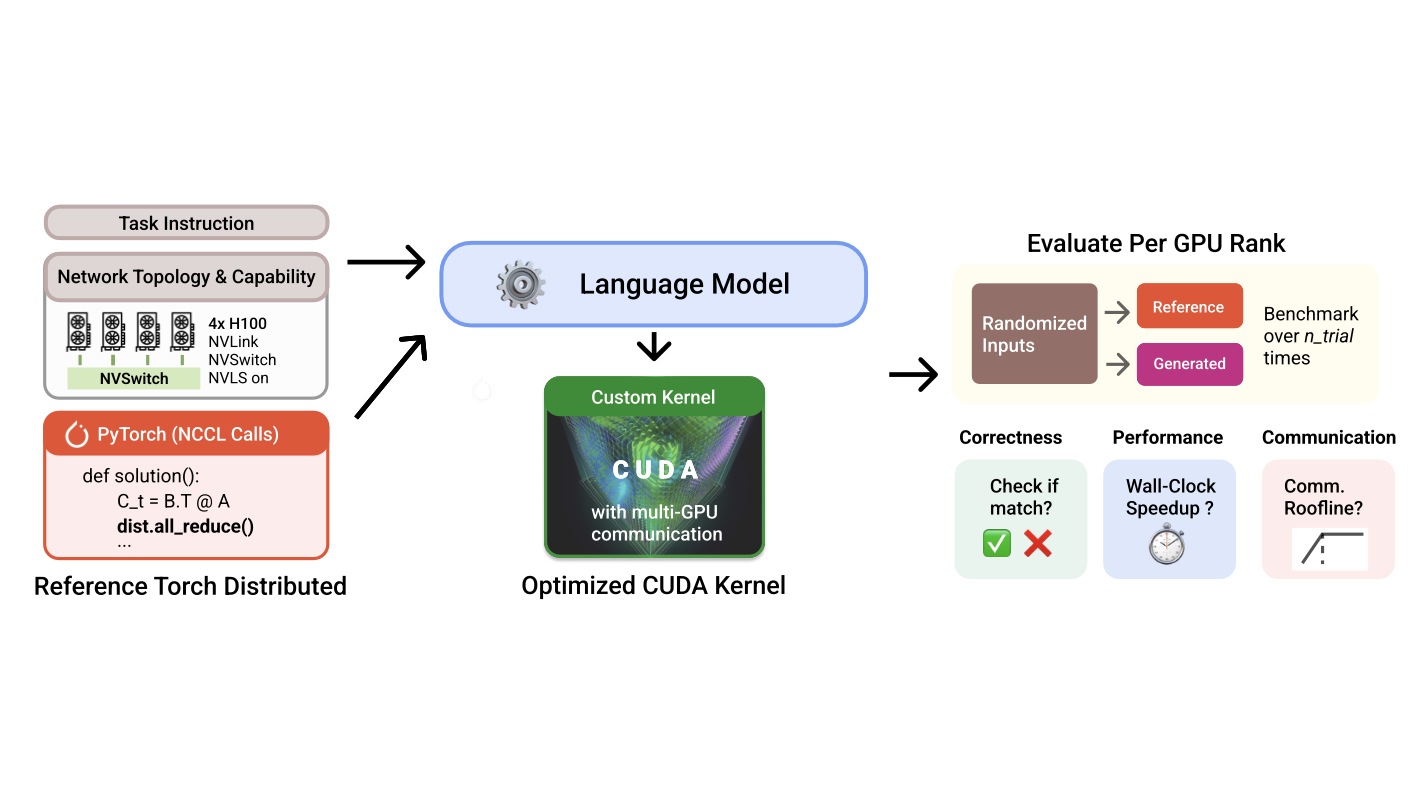
A piece of AI-written code can compile, return a plausible answer and still fail to make expensive hardware useful. That is especially important when the program spans several GPUs. Work must be divided correctly and the devices must exchange information in the right order. A mistake can produce a wrong result, a stalled computation or a program that is slower than the code it was supposed to improve.
For teams building large AI systems, the attraction of automated kernel optimization is obvious: software improvements could extract more useful work from hardware already purchased. But a benchmark that rewards only syntactically valid code cannot establish that benefit. Correctness and speed are separate requirements, and communication between devices adds another layer of difficulty.
A benchmark for the distributed case
Together AI's June 23, 2026 ParallelKernelBench release describes the benchmark. This article examines that dated release rather than presenting it as new October news. The benchmark contains 87 distributed workloads drawn from production codebases and covers multiple forms of parallelism. Models must replace PyTorch and NCCL reference implementations with lower-level GPU code.
In the company's reported zero-shot evaluation, the strongest model solves 28 of the 87 problems correctly. With three attempts, the best reported result reaches 36 correct solutions, of which 27 also beat the baseline. Those are different thresholds. A correct solution is necessary, but it does not automatically deliver the performance gain that motivates optimization in the first place.
Why several GPUs change the problem
On one device, an optimizer must already contend with computation, memory movement and the machine's available execution resources. Multiple devices add questions about who owns each part of the data, when another device can use it and how much communication can be overlapped with useful work. A locally sensible operation can become globally wrong if the participants disagree about those boundaries.
This is why a general coding score does not answer the specific question the benchmark asks. An AI system may know the syntax of a GPU language while struggling to coordinate a distributed operation. It may also produce a functionally correct sequence that leaves time on the table through unnecessary synchronization or communication. The gap between those outcomes is an engineering problem, not merely a matter of generating more code.
The benchmark's value is to make that gap measurable within a defined setting. It does not show that every distributed kernel is equally difficult or that no AI-generated optimization can be useful. A few strong outputs and many failures can coexist. The task is to determine which outputs deserve trust and where the testing effort must be concentrated.
Feedback is useful, but it costs something
The release also investigates an agentic process in which generated code receives compilation, correctness and performance feedback. That is closer to an engineer's iterative workflow than a single unassisted answer. It creates a better opportunity to discover and fix a defect, while adding experiment time and resource use that should remain visible in the comparison.
For users, this means that a model ranking needs its execution protocol beside it. A result obtained with repeated attempts or a feedback loop is not the same claim as a one-shot success. An organization choosing an automated optimization approach should consider both the quality of the final candidate and the cost of finding it. Otherwise, an apparent saving in the final kernel can hide an expensive search.
The immediate practical use is a controlled evaluation environment. Teams can examine whether a proposed optimization produces the right distributed outputs before asking whether it is faster. They can then compare it against a meaningful reference on the intended hardware. That is more informative than accepting a generated implementation because it resembles code that usually performs well.
The scope must travel with the result
The published project is scoped to intra-node NVLink communication. The authors identify inter-node fabrics and other hardware as further research directions. That limitation is central: success inside one closely connected machine does not establish success across a networked cluster with a different communication system.
Nor does this benchmark by itself prove that an AI agent can maintain production infrastructure. Operational code faces changing shapes, software versions, failure modes and workloads. A benchmark result can help prioritize investigation, but moving a candidate into a service still requires engineering judgment and appropriate validation. Those are additional deployment questions, not hidden accomplishments of the published evaluation.
If progress continues, automated systems might eventually help optimize a broader share of the software connecting large AI models to their hardware. That could make performance improvement less dependent on a small pool of specialists for every routine case. The promise depends on reliable verification and a realistic accounting of the search cost, especially when a generated change affects shared infrastructure.
The next evidence to watch is whether improved systems raise both the number of correct solutions and the number that are genuinely faster, under clearly stated attempt budgets. Broader hardware and communication settings would then test transfer. ParallelKernelBench's useful contribution is a sharper standard: code that runs is only the beginning when the goal is making several expensive machines work together efficiently.
References
Questions, news tips or corrections? Contact [email protected].