
Improving an AI model is not always a steady accumulation of capabilities. A stage that makes the system better at working through software repositories can weaken an ability trained earlier, such as using very long context. For teams building adaptable agents, the larger challenge is preserving a useful balance while adding specialized skills. A model that wins one test may still require deliberate repair before release.
NVIDIA's Nemotron 3.5 Super and Lightning technical release on October 14 describes that balancing work explicitly. The company combines distillation, longer-context stages, specialized mid-training and post-training into a released model family. The important training story is the sequence and its checks, rather than simply a larger count of training tokens. All experimental outcomes discussed here are NVIDIA's reported results, not independent replication.
The main contribution
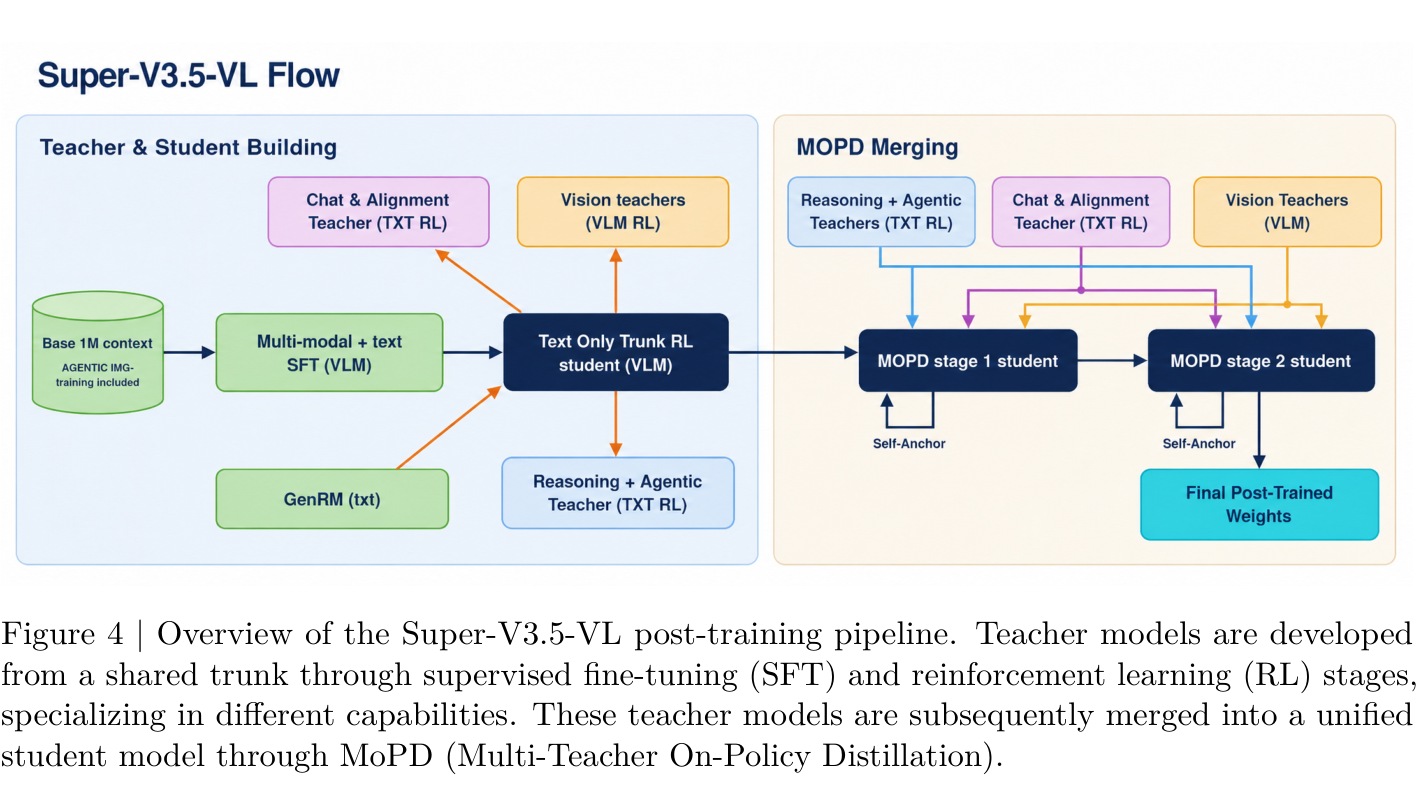
Nemotron 3.5 Super is a hybrid mixture-of-experts model with approximately 120 billion total parameters and 12 billion active parameters. Its post-training combines supervised examples, reinforcement learning with verifiable rewards, human-feedback training and multi-teacher on-policy distillation. The company describes separate teachers for capabilities including reasoning, agentic behavior, alignment, video and visual tool use.
Distillation means teaching one model using signals from another. In an on-policy setting, the student's own behavior is part of the learning process, helping align the teaching signal with situations the student actually encounters. Multiple teachers can provide different specialties, but combining them creates a coordination problem: their strengths must survive in one student without introducing incompatible behavior or sacrificing previously useful capabilities.
A concrete case of recovery
The release describes an agentic software-engineering mid-training stage at 256,000-token context. It then reports that this stage reduced performance on a one-million-token RULER test. A final long-context recovery stage raised that score from 33.5 to 81.0. The sequence provides a specific example of a capability weakening after another training intervention and then being deliberately restored.
That result should be read as evidence about the tested recipe and benchmark. RULER is not every long-document workflow, and recovery on it does not guarantee complete evidence retention in arbitrary repositories or conversations. The important lesson is methodological: measure what a specialized stage changes elsewhere, then make restoration an explicit decision rather than assuming earlier training remains intact.
Why sequence matters to developers
A developer might otherwise compare only a base checkpoint and a final checkpoint. That hides which stage introduced a benefit or a regression. Intermediate evaluations create a more useful account of cause and trade-offs. They can show whether the model needed more relevant examples, a different training objective, a recovery phase or a narrower definition of success before the final result was reached.
The same principle applies when a smaller team adapts a pretrained model. A domain improvement should be checked alongside general capabilities the application still needs. The relevant tests may include instruction following, factual accuracy or performance on older tasks. A recovery stage is not automatically the right solution; sometimes the specialization itself should be changed or rejected. The decision should follow evidence.
What the reported results establish
NVIDIA reports gains in software-engineering and agent benchmarks, alongside released checkpoints and recipes. These support the claim that the company has built and evaluated a staged training system. They do not isolate every component's contribution or establish that all improvements come from post-training alone. Architecture, pretraining, inference configuration and tool harnesses also affect a final benchmark result.
Some reported gains involve running parallel agents and self-verification at inference time. Those should not be confused with gains in the underlying weights. Spending more runtime computation can change the outcome even when a checkpoint is unchanged. A useful comparison records both training decisions and evaluation-time resource use, so a reader knows which part of the system delivered the measured improvement.
What changes immediately
For practitioners, the release supplies a recipe to inspect and a caution against measuring specialization in isolation. Before adding another training stage, teams can define the capabilities they intend to preserve, select held-out tests and retain intermediate checkpoints. That makes it possible to identify regressions early and compare the cost of recovery with the value of the new capability.
For buyers of adapted models, this suggests asking for more than the strongest final score. Useful evidence includes before-and-after results across the capabilities relevant to the workflow, details of the evaluation harness and the amount of inference-time assistance. A model that has been carefully balanced may be more valuable than one optimized for a narrow leaderboard result, even if its headline number is less dramatic.
The bigger picture
If staged training and teacher consolidation become more reproducible, organizations may adapt capable models while retaining a clearer account of what changed. That could reduce the risk of silent regressions as agents acquire new tools and responsibilities. It remains conditional on representative tests: a carefully documented sequence can still preserve the wrong set of capabilities for the eventual application.
The next evidence to watch is independent reproduction, component-level ablations and tests that follow capabilities across successive updates. NVIDIA's reported recovery is a reminder that progress is a balance to maintain. The durable advance would be a training process that can explain not just what a model gained, but what it lost, what was restored and what remains uncertain.
References
Questions, news tips or corrections? Contact [email protected].