Many useful AI models do not need to become frontier generalists. They need to recognize a narrow set of conditions, fit on a particular device or perform one familiar transformation well. The obstacle is often the experiment around the model: collecting data, establishing a baseline, launching compatible training, evaluating the result and producing something another person can inspect. Making that process easier could widen who can build specialized tools.
Hugging Face's October 8 account of ML Intern presents conversational assistance for that workflow. The author describes several adaptation projects that begin with a specification and end with public artifacts. The meaningful development is not that a model trained itself without direction. It is that an agent can coordinate many practical steps while the user supplies the goal, limits spending and reviews the evidence.
The main contribution
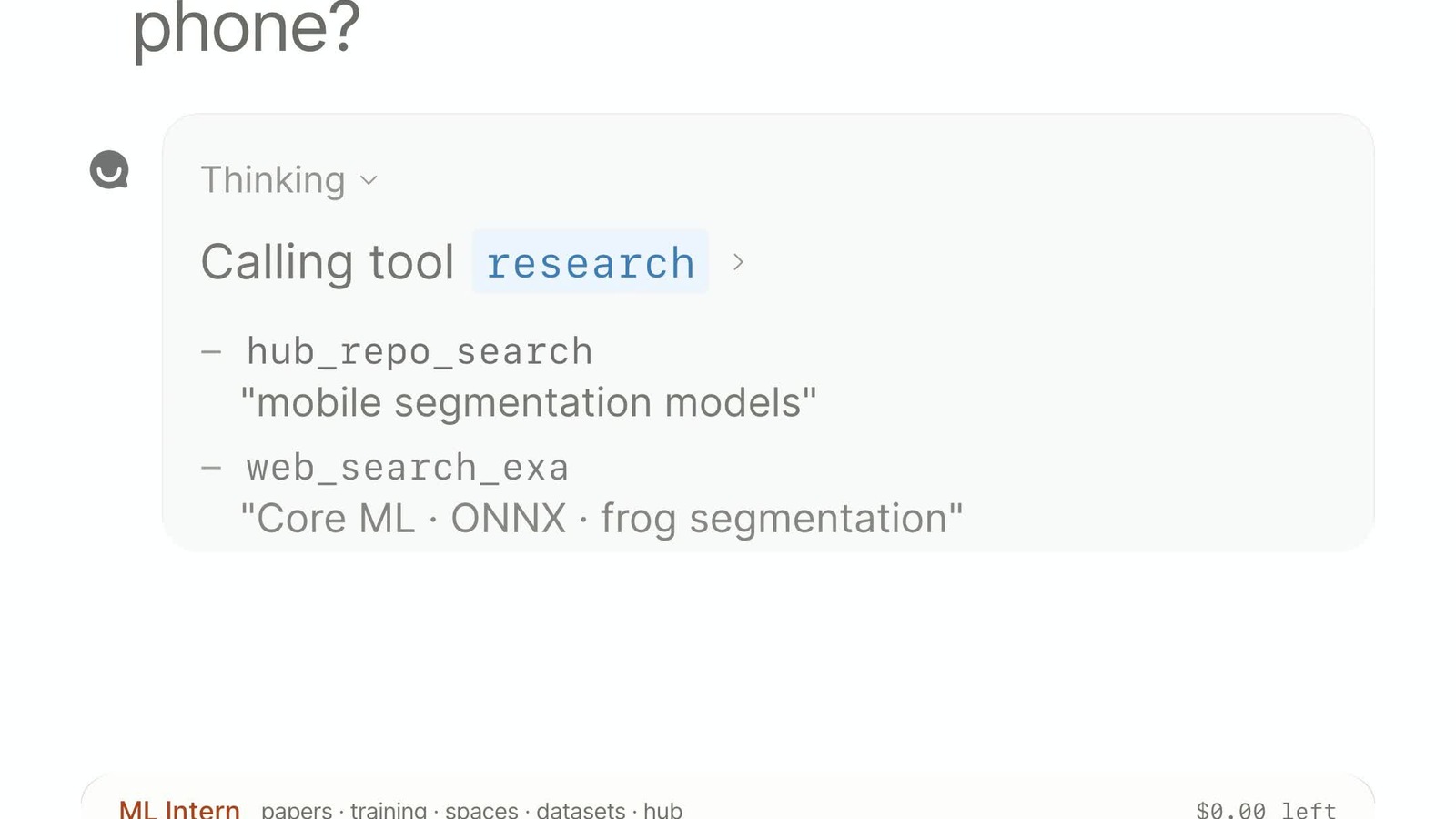
ML Intern operates through HuggingChat and can plan work, propose a budget, run a small test, train, evaluate and publish on Hugging Face infrastructure. The examples include a smaller prompt rewriter, a domain-specific vision model and image-model adapters. The common structure is a task definition that names the desired behavior and asks for explicit deliverables rather than merely requesting a better checkpoint.
The post emphasizes a baseline before training and a smoke test before a full paid run. These are not decorative process details. Without a baseline, a completed model gives no direct evidence that training helped. Without a working small run, a long job can spend its budget producing unusable artifacts. The agent's value partly lies in making those checks easier to perform consistently.
What the examples show
In one reported project, a citrus-image model improved from 14.9 percent to 52.8 percent accuracy on 335 test photographs after adaptation. In another, a prompt rewriter was reduced from a much larger teacher to a smaller student. These company-hosted author experiments illustrate specific workflows. They are not independent estimates of the performance a new user will achieve on another dataset.
The cost figures also require a careful reading. The post identifies them as GPU and CPU job charges. They do not include every minute of human preparation, data review, unsuccessful product design or later maintenance. A small compute bill can make an experiment accessible while leaving substantial work before deployment. Readers should avoid interpreting an attractive example price as a quote for a complete reliable application.
Why an agent does not remove experiment design
A training agent follows a specification. If the evaluation metric misses the actual problem, automation can make it easier to optimize the wrong thing. A leaf classifier with good held-out accuracy might still fail on unfamiliar lighting or plant varieties. A compact text model might produce valid output formatting while changing the meaning that a downstream system needs. These questions must be built into the experiment.
The examples also show that progress includes failures and retries. Missing packages, paths and checkpoint choices remain part of the workflow. An agent can repair some of these issues, but a record of what changed is necessary for reproducibility. A successful final run does not make earlier assumptions disappear. The artifact should identify its data, software versions, training configuration and selection rule.
What changes immediately
For a developer or domain specialist, ML Intern lowers the effort required to test whether a modest adaptation is worthwhile. A useful first request defines a narrow task, a dataset the user can lawfully use, an existing model and a measurable baseline. A capped budget and small compatibility test create a review point before committing to a larger run. This makes the process more inspectable as well as more accessible.
For teams, the opportunity is to standardize evidence across many small experiments. Instead of receiving an isolated model file, reviewers can ask for comparable baseline scores, test splits and raw predictions. This can improve the decision to stop as much as the decision to continue. If adaptation offers little benefit, a documented negative result can prevent unnecessary deployment complexity.
The wider impact depends on judgment
If conversational tooling makes specialist experiments easier to reproduce, a broader group of people may test models tailored to their own work. That could support applications too narrow for a large provider to prioritize. However, easier training does not guarantee a useful dataset, representative tests or permission to distribute the result. Those remain responsibilities of the team building the application.
There is also a distinction between producing an artifact and operating it. A model may need monitoring, versioning, rollback and fresh evaluation when its inputs change. An experiment assistant can help prepare that evidence, but it cannot establish reliability merely by reporting that a training job finished. Real adoption depends on the behavior of the saved checkpoint in the environment where it will be used.
The next evidence to watch is independent replication of the published projects and transparent failure rates across new users and tasks. The larger contribution would be making sound experimental habits routine: measure before training, inspect a small run, preserve the evidence and expand only when the result justifies it.
References
Questions, news tips or corrections? Contact [email protected].