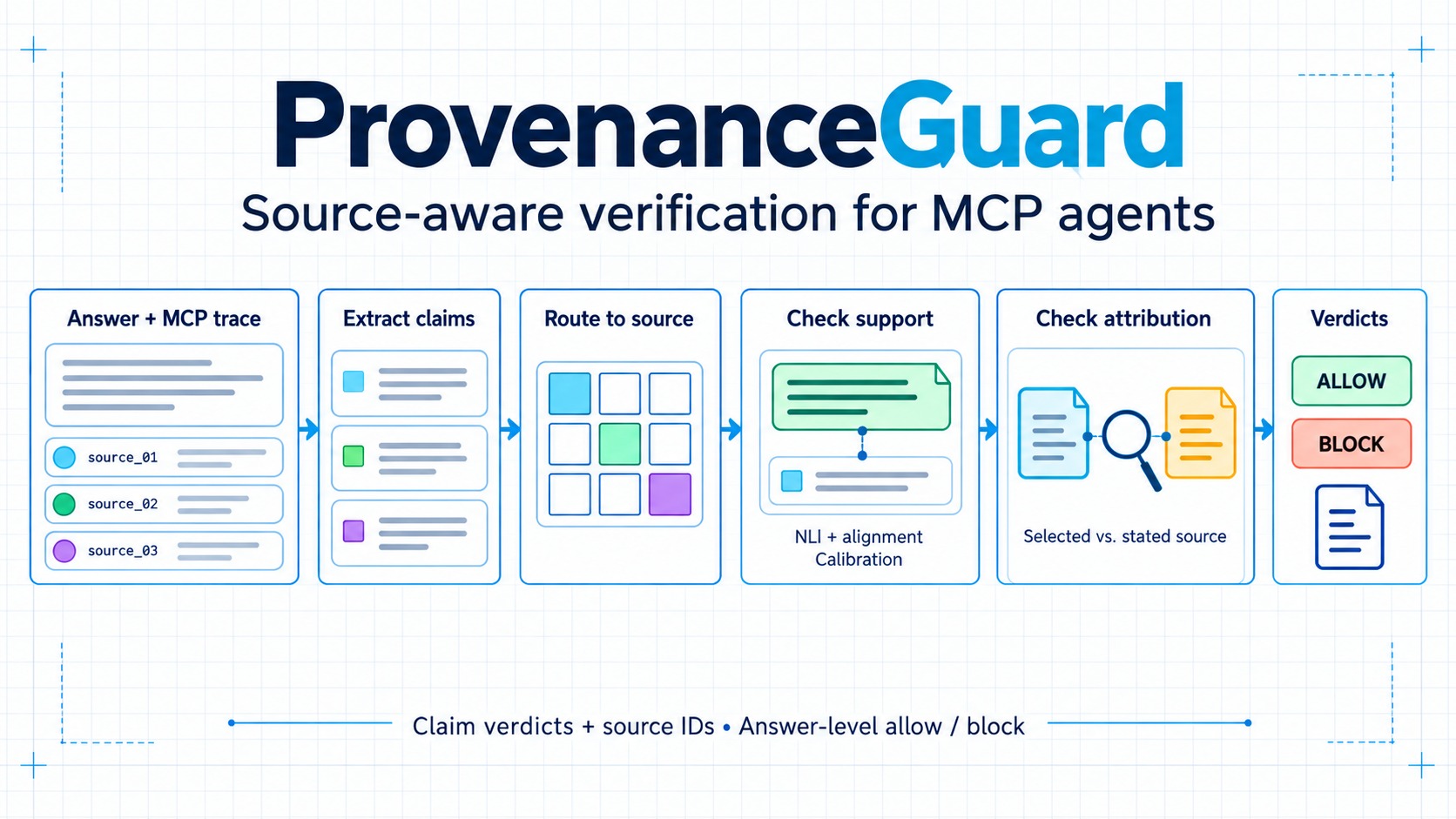
A statement can be true and still be misleading when it is credited to the wrong record. An agent reading several tools may mix a general policy with an individual account, leaving the reader unable to tell which evidence actually supports the answer.
Multiverse Computing's September 29 account of ProvenanceGuard describes a verification layer that preserves source identities across a tool trace. It separates claims, selects supporting sources, checks support and compares that source with the attribution in the answer. The reported setup uses local components and does not require retraining the underlying agent. Primary source.
Blocking has two costs
The authors report that their held-out expert review caught 138 of 139 claims judged unsuitable to pass, while also holding 67 claims experts considered supported. Those numbers describe a conservative operating point, not error-free verification. False blocks create review work and can prevent useful answers from reaching a user.
The harder source-disambiguation test also matters: similar sources make attribution more difficult even when a system can recognize that a claim is problematic. Detecting a mismatch and selecting the correct replacement are separate abilities.
Repair should be assessed with equal care. A safe fallback can resolve a verification failure without providing the substantive answer originally requested. Reporting that outcome separately prevents completion metrics from hiding lost usefulness.
Preserve the evidence path
For teams building tool-using agents, the immediate lesson is to retain source identity before generation and through later verification. Once all evidence has been flattened into an anonymous context, reliable attribution becomes harder to reconstruct.
Source-aware checks could improve accountability in multi-tool workflows if their review burden and domain-specific error rates remain acceptable. The next evidence is performance beyond the reported medical traces, including comparisons with simpler source-aware verification approaches. A factuality score should make clear whether it means supported somewhere or supported by the source the answer names.
Source organization: Multiverse Computing. Source statements are attributed; operational implications and suggested evaluation criteria are editorial analysis.
References
Questions, news tips or corrections? Contact [email protected].