For many people, the limitation of an AI assistant is not whether it can produce another paragraph in English. It is whether it can explain a technical concept, follow an instruction or handle familiar language in the script they actually use. Training material affects who receives useful AI capability. Expanding that material is therefore an access problem as well as a model-building problem.
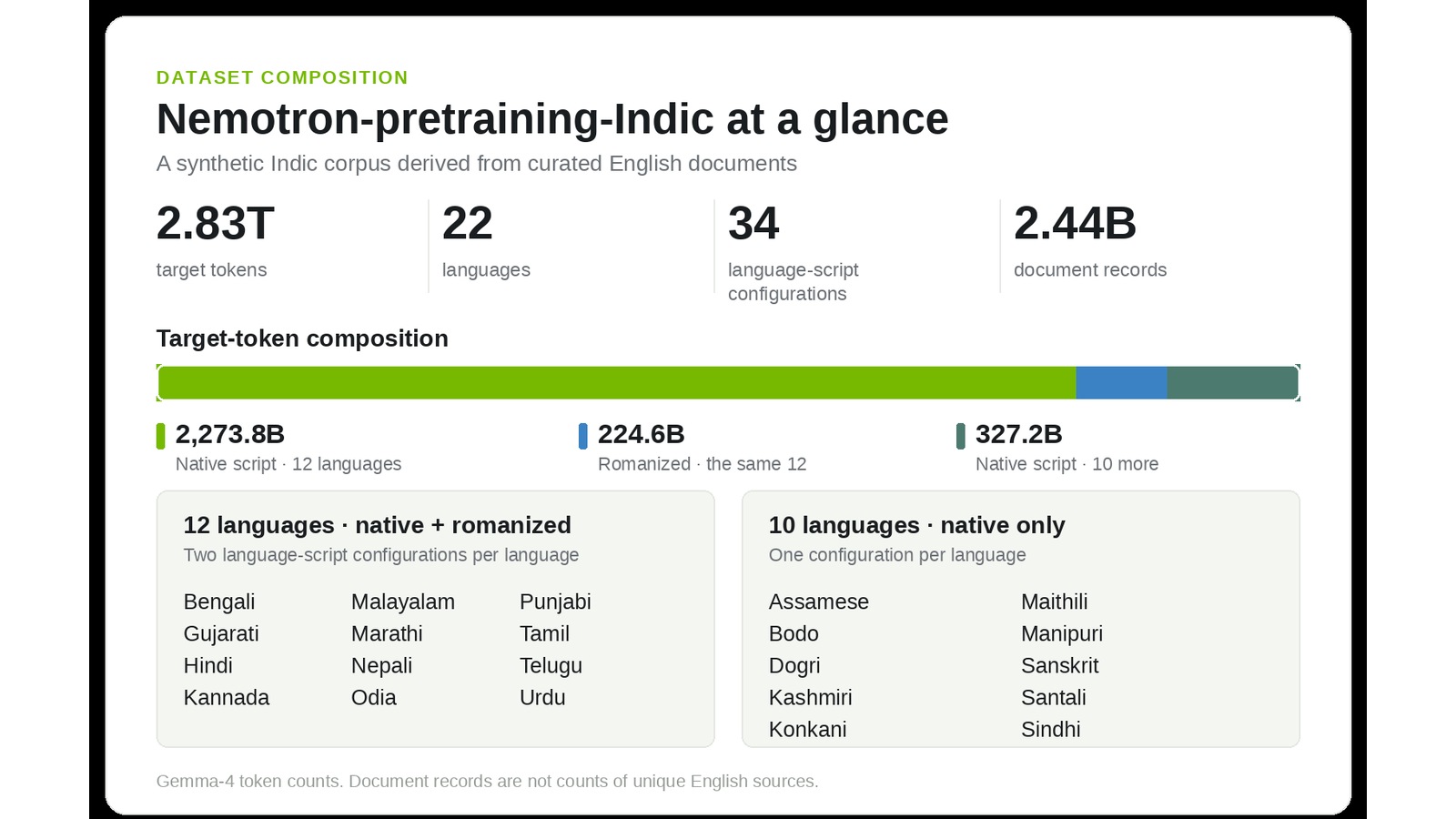
NVIDIA and AI4Bharat's October 16 announcement addresses one part of the gap with approximately 2.8 trillion tokens across 22 Indian languages and an open generation recipe. The distinction between announcement and availability matters: the company describes the corpus as releasing soon. The published workflow can be examined now, but the announcement should not be represented as proof that every promised dataset configuration is already downloadable.
The main contribution
The project translates curated English source documents into Indian languages, with native-script coverage for all 22 languages and romanized material for twelve. The workflow preserves source identifiers and checks generated text against its input. Developers gain both a planned corpus and a method they can adapt to their own source material, rather than only a finished model whose language mixture remains opaque.
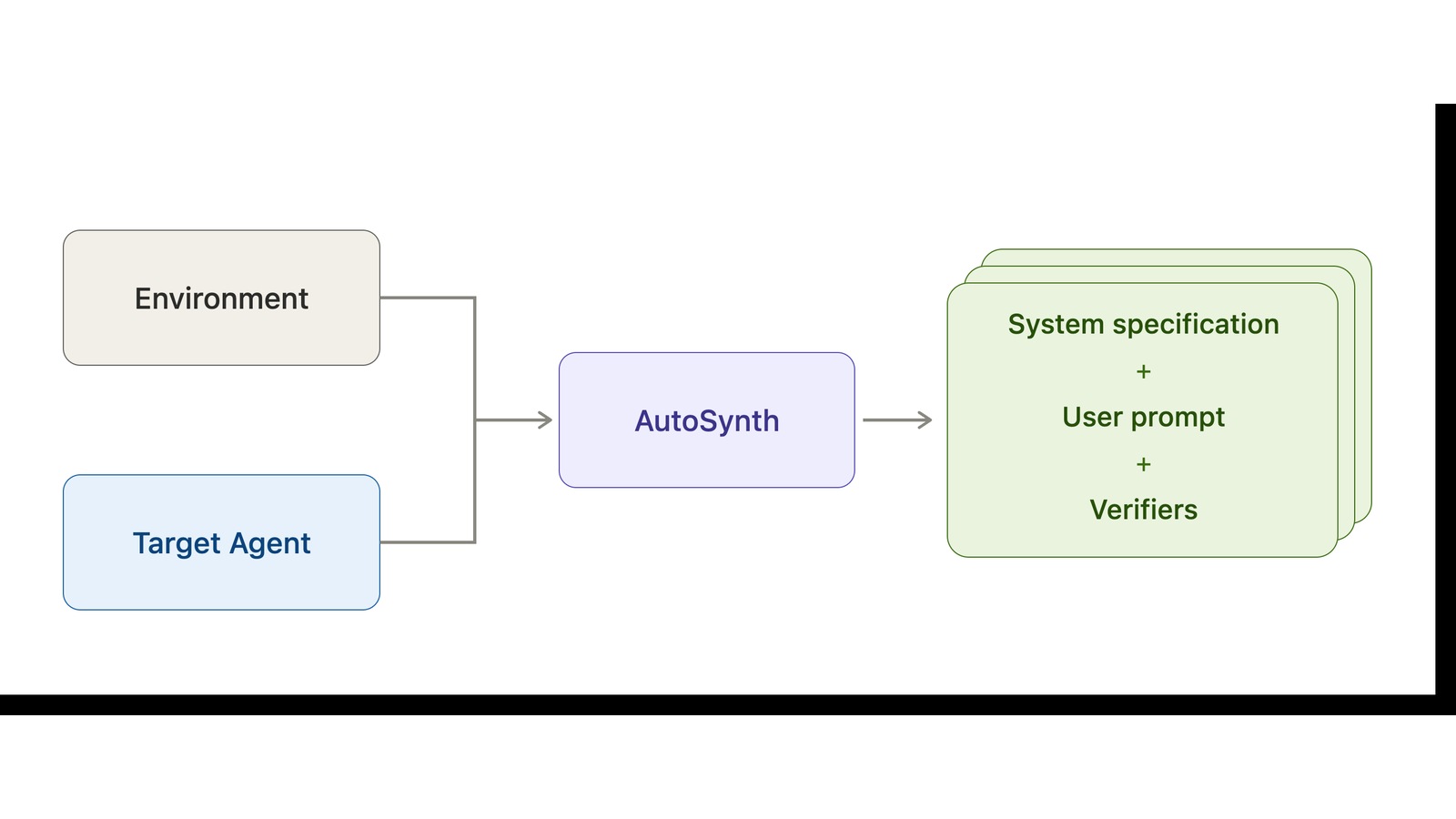
For the twelve-language workflow, translation is followed by quality assessment, targeted repair of weaker outputs and optional conversion to Latin script. Other languages use a different translation path with language-specific handling. This is a consequential detail: one generation recipe is not assumed to work equally well for every language or writing system. The system's structure reflects that coverage requires engineering choices.
Why the accounting needs care
A token is a unit used by a model's tokenizer, not a unique fact or a distinct source document. Translations and script variants can repeat the same underlying material. A corpus containing trillions of tokens therefore should not be understood as trillions of independent examples. The published counts describe retained inventory, while a particular training run may consume only a fraction of it.
That distinction also affects evaluation. If one source document appears in several languages, a simple random split can place closely related versions on both sides of a train-test boundary. A cautious experiment groups derived records by their source and records the revision being used. Otherwise, an apparent improvement may partly reflect repeated content rather than transfer to genuinely unfamiliar material.
The evidence is narrower than the headline size
The company reports that an Indic continued-pretraining stage improved several knowledge and reasoning benchmarks. It explicitly notes that the stage combined natural and synthetic Indic text. Those results support the combined recipe; they do not isolate the effect of the entire synthetic corpus. Likewise, comparisons between final model generations include additional training changes beyond the data announcement.
The authors identify automated quality assessment and sampled human review as limitations. In one workflow, the translating model also serves as the judge. A high internal score is therefore a filtering signal, not a guarantee of correct meaning. Native-speaker checks remain necessary, especially for omissions, residual English, specialist terminology and languages with less human review coverage.
What changes immediately
For model builders, the immediate opportunity is a more inspectable experiment. They can begin with a limited set of languages, compare fixed token budgets and record natural-versus-synthetic and native-versus-romanized shares. A good evaluation should examine not just question accuracy, but language fidelity, script consistency and whether English capability is retained. These dimensions can move differently.
For organizations deploying multilingual services, the announcement is a reason to request better language-specific evidence from suppliers. Aggregate multilingual results can conceal weak performance for a language or script central to a customer population. A support service also needs to understand local terms and intent. Its success cannot be inferred solely from translated technical documents or an overall token count.
The broader impact depends on local knowledge
Translation can extend access to information that already exists in English. It cannot substitute for material originally written by the communities a system serves. Local institutions, culture, idiom and practical knowledge may be absent from the starting documents. The most useful future mixture may combine translated technical coverage with appropriately sourced natural-language material and targeted human feedback.
If the corpus and recipe support reproducible gains across independently tested models, the project could lower one barrier to building capable Indic systems. That outcome remains conditional on licensing, quality and representative evaluation. Large-scale generation makes it easier to create text; deciding which text deserves to teach a model remains the harder part.
The next evidence to watch is actual dataset availability, stable revisions, per-language audits and controlled mixture studies covering the full announced corpus. The bigger picture is participation: more training material can broaden who benefits from AI, but only when the data preserves meaning and reflects the people whose languages appear in its inventory.
References
Questions, news tips or corrections? Contact [email protected].