Apptronik’s Robot Park announcement is easy to read as a larger building for a newer robot. Its more consequential feature is a change in what the fleet is for. Apollo 2 operates as a source of physical experience feeding the Google DeepMind collaboration. A robot can contribute useful training data before it is ready to perform every job without assistance. That makes the learning operation distinct from the eventual labour product.
June’s announcement linked a facility, a platform and a model partner
On June 30, Apptronik introduced its expanded Austin Robot Park and publicly described Apollo 2 in wheeled and bipedal configurations. The nearly ninety-thousand-square-foot site anchors related data-collection activity at partner and customer locations. The company identifies Google DeepMind, Mercedes-Benz and GXO in that network.
Teleoperation and autonomous execution both contribute experience used to refine Gemini Robotics. Apollo 2 had already served as a training workhorse for more than a year. Apollo 3 was described as the upcoming commercial generation. These dates and roles matter: this is a June infrastructure announcement, not a newly released October robot or proof that the whole fleet is autonomous.
Wheels can change the data opportunity
The two bases create different operating choices. Apptronik says the wheeled configuration is designed around existing industrial mobile-robot safety standards, while the walking configuration pursues adaptability in more complex environments. The company does not provide a controlled comparison of how much each configuration improves the resulting model.
The strategic implication is nevertheless concrete. A base that fits an existing workplace can enable repeated manipulation experience there, even when walking is unnecessary. A biped can expose the programme to different whole-body demands. Treating both only as competing answers to “what should a humanoid look like?” misses their role as instruments for collecting different interactions.
The useful dataset is determined partly by where the hardware is allowed to operate and what it can attempt repeatedly, not only by the nominal capability of its neural model.
The operational software determines what the fleet can teach
Apptronik’s current Apollo 2 platform page separates the robot, its Artemis coordination layer and Fleet Connect. The latter is described as handling robot status, task orchestration, deployments and data collection. The platform also includes swappable batteries and several charging options. These are operating provisions rather than a published measurement of learning progress.
Their relevance is that a training fleet needs continuity and context. A failed manipulation is more informative when the team knows the task, the intervention and the robot state. More uptime can create more observations, but useful learning also requires deciding which observations reveal a weakness worth addressing.
This is where fleet operations and model development meet: the system managing work can also determine whether the experience is usable by the next training cycle.
A continuous loop still needs a measured return
The company describes a loop of work, collection and improvement. The announcement does not quantify autonomy rates, data yield per shift or a before-and-after model gain attributable to Robot Park. Those are the measurements that would establish whether a larger collection operation is producing a better commercial system rather than simply more footage.
A useful return might appear as less teleoperation on a repeated task, better recovery after a disturbance or fewer demonstrations needed at a new site. Those are different outcomes. Reporting them separately would let customers see whether learning is reducing their operating burden, while keeping the cost of human participation visible.
The fleet can be valuable before it is the finished product
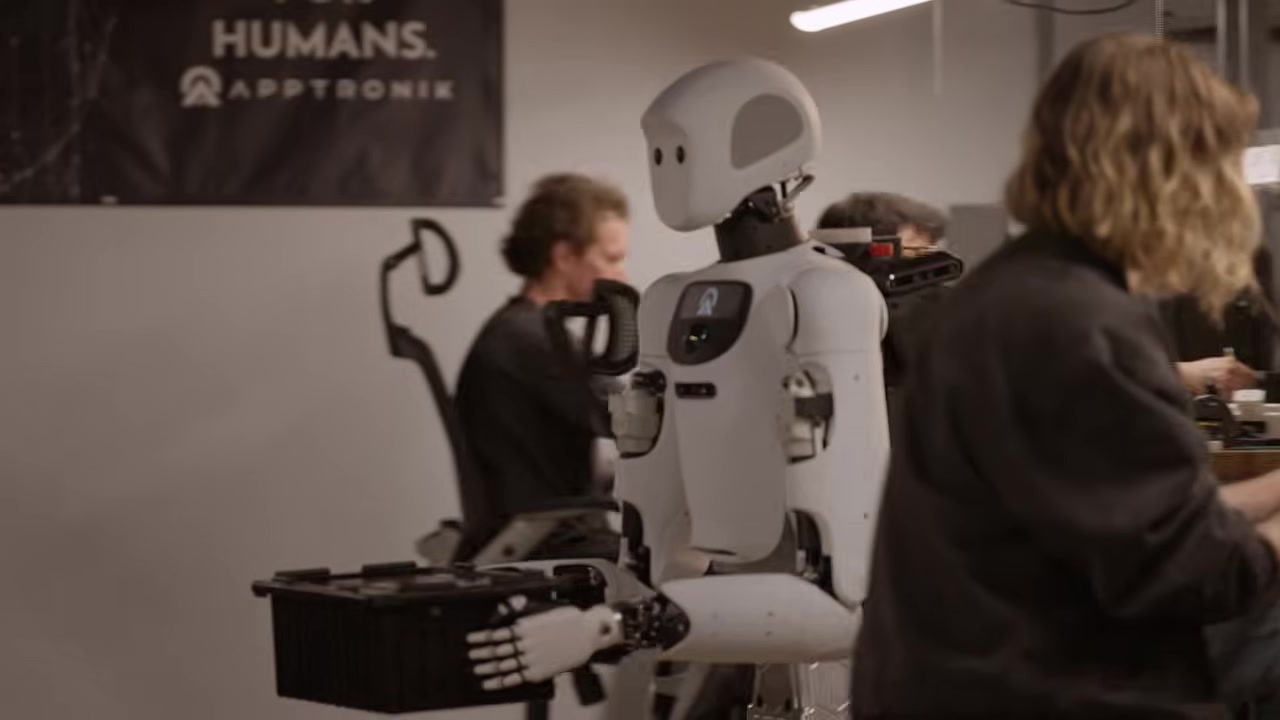
The official Robot Park film shows the platform and collection setting, providing a useful view of the programme without establishing production economics. The company’s distinction between today’s Apollo 2 workhorse and a later commercial generation should remain intact when assessing it.
Apptronik is building an asset that spans hardware, deployment access and repeated physical experience. If that asset makes future model improvements cheaper or faster, the early fleet can create value beyond the tasks it already performs autonomously. The test is whether that accumulated experience survives into a demonstrably more useful robot, not whether the facility can keep producing attractive demonstrations.
References
Questions, news tips or corrections? Contact [email protected].