Customizing an AI system is easy to justify when the starting point is a task that repeatedly goes wrong. It is harder to know whether the customization fixed the task or merely taught the system to satisfy a narrow score. Microsoft's expanded Frontier Tuning preview makes that distinction central to enterprise AI. Giving a company's experts more control over evaluation is a useful advance, provided their preferred examples do not become the only definition of success.
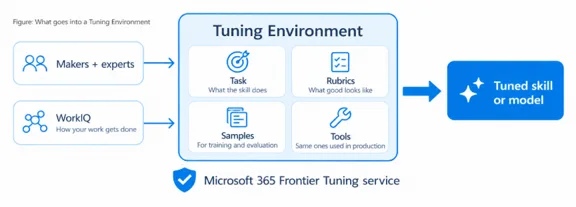
Microsoft's November 18 update adds tools for customers to build and run their own tuning environments. These include a GitHub Copilot plugin, a command-line interface and APIs, and a route to publish approved skills into Cowork. GPT 6 Luna and MAI Code 2 Flash are available in the private preview. This is an expansion of a controlled preview, rather than general availability of every feature shown.
The standard is part of the product
The important design choice is to put the task, expert scoring criteria, examples and production tools in the same evaluation environment. Microsoft describes separate training and evaluation samples and repeated rounds that retain improvements. Teams decide which version reaches users. The mechanism could make customization more inspectable because a change can be linked to the standard it was intended to improve.
That standard remains a human responsibility. A rubric can reward a convincing answer while overlooking an unsupported assumption. It can penalize a cautious answer that correctly identifies missing evidence. Before optimizing a system against the rubric, a team should test whether qualified reviewers agree with its judgments on difficult cases. Disagreement is evidence that the definition of good work needs attention, not necessarily that the model needs more training.
The source demonstration uses an invoice-review scenario to show expertise moving into a skill, evaluation and deployment. It is an edited product demonstration, not an independently measured customer result. Its useful contribution is to make the proposed sequence visible. It should not be read as proof that every organization can capture its experts' reasoning through the same brief interaction.
Hold back the cases that could change your mind
Separating training and evaluation examples is necessary, but repeated optimization against one evaluation set can still make that set less informative. If a team sees every failure and adapts until the score rises, it has gradually used the test to guide development. A final assessment should therefore include cases that did not influence the changes, with enough variation to expose differences in documents, tools and task difficulty.
The strongest alternative explanation for a higher score is a narrower system. It may have improved at the common workflow while becoming worse at recognizing when that workflow does not apply. That risk is particularly relevant when expertise includes knowing when to ask another person. A useful comparison should count appropriate deferrals, unsupported answers and correction effort alongside completed tasks.
For customers, the immediate opportunity is to compare smaller changes before committing to model adaptation. Altering instructions, retrieved context or tool behavior may solve a problem at lower operating complexity. The choice should follow evidence from the same tasks and review standard. A better model score is not sufficient if the revised workflow increases latency, requires more supervision or depends on fragile integrations.
The learning loop needs a release boundary
Allowing users to return useful examples can help a system track changing work. It also creates a responsibility to decide which examples belong in the next training set. A complaint can expose a real weakness, a rare exception or an incorrect expectation. Treating all feedback as an equally valid training signal would replace expert judgment with a collection process.
A well-managed release should preserve the previous version, explain the proposed change and make its comparison reproducible. The same production permissions and tools should be represented in testing. Otherwise, a skill may succeed in a convenient development environment and fail when ordinary users encounter access restrictions or missing records.
The longer-term promise is an organization that can improve its AI systems against an explicit, evolving account of good work. The limiting resource may become the quality of that account rather than access to tuning machinery. Frontier Tuning is a meaningful step toward putting the process in customers' hands. The next evidence to watch is improvement on genuinely held-out work, measured with review burden and operating cost, rather than a rising internal score alone.
Questions, news tips or corrections? Contact [email protected].