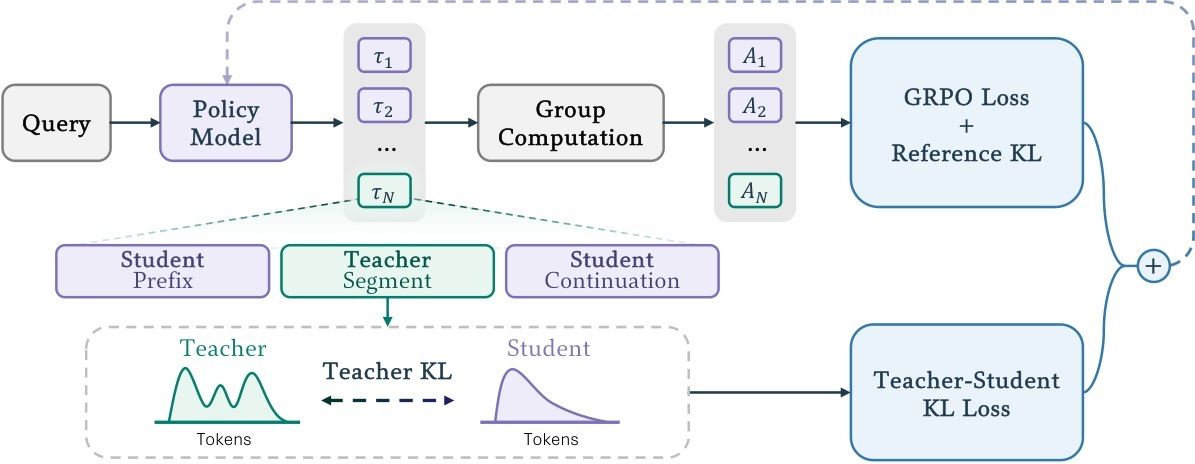
A training method that rewards only a correct final answer can learn little from a group of attempts that all fail. A stronger teacher may know how to recover, but showing a successful solution does not establish that the student can reproduce the correction.
University of Chinese Academy of Sciences, Tsinghua University and Chinese Academy of Sciences researchers present PIVOT in an October 29 preprint. A student generates a prefix, a teacher inserts a correction segment, and the student continues. The method combines verifier-based reinforcement learning with token-level teacher–student KL supervision on the correction. On the reported logic-game evaluation, mean avg@8 rises from 19.5 percent for the best baseline to 35.6 percent. Mathematical reasoning is also evaluated; these are benchmark-specific research results. Read the primary source account.
Reaching a reward and learning the correction differ
The design distinguishes trajectory-level intervention from token-level supervision. An inserted segment can help an attempt reach a reward-bearing outcome, while a dense learning signal can help the student learn what happened inside that segment. The controlled comparisons motivate using both. Treating the teacher as one undifferentiated extra resource would miss the mechanism the experiment is trying to isolate.
The placement of the intervention also matters. A correction arrives in a reasoning state created by the student, rather than solely as a complete solution written from the beginning. That can connect guidance to mistakes the student actually makes. It also means the correction policy and the distribution of student prefixes become part of the training recipe.
Teacher work belongs in the comparison
For developers, the immediate contribution is a specific way to supply informative trajectories when outcome rewards are sparse. A useful reproduction needs to retain teacher generation and supervision costs alongside student rollouts. More successful attempts are valuable, but the budget required to obtain them determines whether the method is a better use of resources for a receiving task.
The avg@8 result is not a claim that a deployed assistant independently solves the same share of arbitrary real-world problems. It is an aggregate over the reported attempts and evaluation setting. Similarly, an improvement on logic games does not establish that the correction method will preserve every other capability. Those are separate measurements that a deployment-oriented comparison would need.
The wider possibility is training that helps a weaker model recover without making the stronger model a permanent runtime dependency. That depends on the student internalizing the guidance and succeeding without intervention. The next decisive evidence is durable unassisted performance on held-out tasks, measured against the full cost of teacher-assisted training.
Source organizations: University of Chinese Academy of Sciences, Tsinghua University, Chinese Academy of Sciences.
References
Questions, news tips or corrections? Contact [email protected].