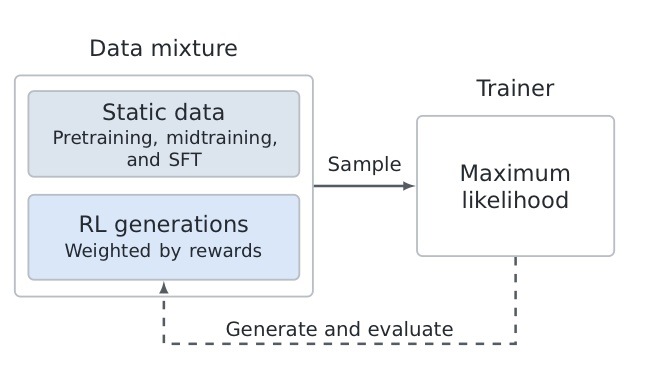
A model’s training stages can use different software and objectives even when they all change the same weights. That makes it harder to tell whether a better final model came from the learning rule, the examples or the timing of the transition.
Carnegie Mellon University, Johns Hopkins University and Aurora Innovation researchers present a unified-training framework in an October 29 preprint. For suitable reinforcement-learning objectives, they derive maximum-likelihood fitting to model-generated target distributions. Static examples and reward-weighted generations can then share a trainer. Their experiments compare accuracy, coverage and retained capabilities across controlled and larger training settings. The claim is a framework and experimental result, not that every reinforcement-learning objective is interchangeable with ordinary supervised learning. Read the primary source account.
One algorithm leaves many data decisions
The formulation shifts attention to which examples enter the mixture, in what proportions and when. A conventional stage boundary becomes one possible schedule: a sharp change in the mix rather than a necessary change in the underlying learning algorithm. The distinction can make lifecycle comparisons easier to specify, but it does not remove the need for reward design or the cost of producing model generations.
The study’s compute comparisons include earlier training stages as well as reinforcement learning. That is important when the final capability depends on what was learned before the last stage began. Comparing only the last update can reward a configuration that moved expensive work into its initialization. A complete comparison has to keep the denominator consistent with the question being asked.
Unified infrastructure is not an automatic universal recipe
The immediate contribution is an inspectable way to experiment with mixed static and generated data. Teams can compare a staged schedule against a smoother mixture without changing every other component of the trainer. That can help isolate whether a capability loss is associated with the examples, the proportions or their timing.
There are still operational differences between reading an existing dataset and generating, evaluating and storing new trajectories. Queueing, verification quality and stale generations affect the implementation even if the loss has a shared mathematical form. The common objective should therefore be understood as a way to organize those choices, not evidence that the surrounding infrastructure disappears.
Over time, this approach could support more continuous learning systems in which retained knowledge and new behaviors are managed through an evolving mixture. Its value depends on reproducible comparisons that preserve total compute and earlier capabilities. The next useful evidence is a clear account of which mixture decisions transfer across tasks, and where the theoretical conditions or practical costs prevent the common trainer from helping.
Source organizations: Carnegie Mellon University, Johns Hopkins University, Aurora Innovation.
References
Questions, news tips or corrections? Contact [email protected].