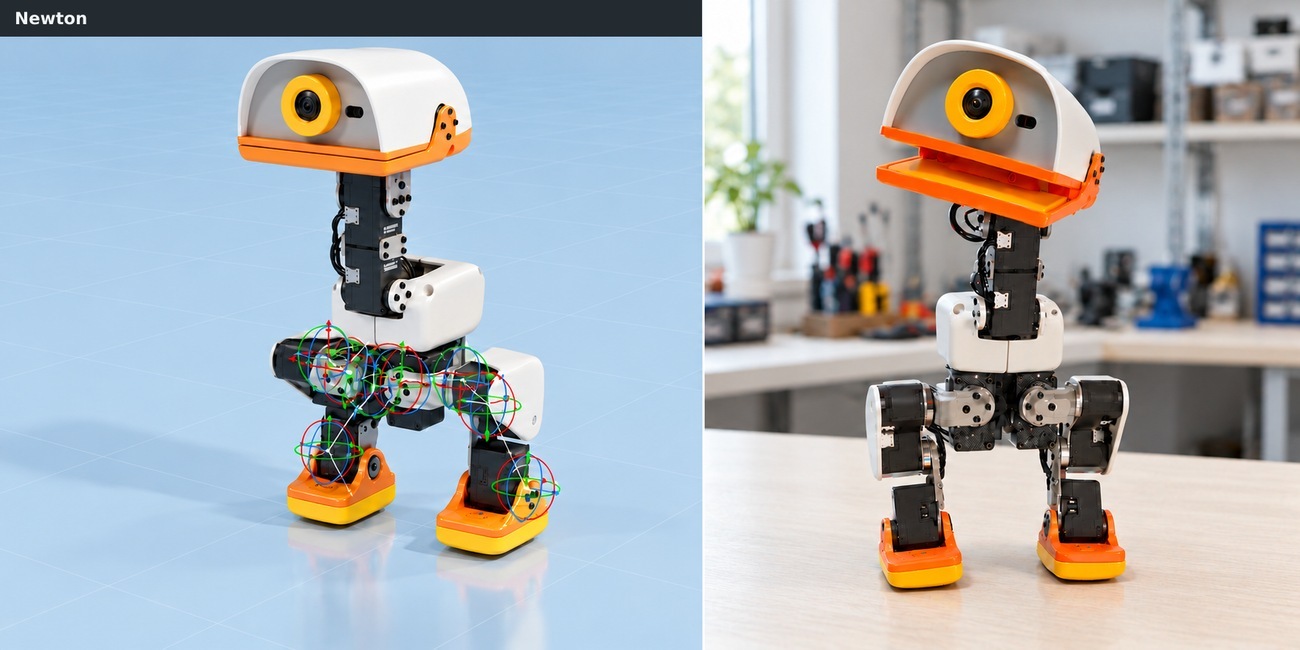
A simulated robot can follow a command precisely while a physical joint pauses, slips or responds late. Those small differences can accumulate in a walking machine, where balance depends on coordinated motion. Training a policy in a simulator is therefore only part of the problem. The developer also needs a defensible account of which physical variations the training environment represents and whether the exported policy receives the same information on the actual robot.
NVIDIA’s October 21 Microduck tutorial describes a workflow using Isaac Lab 3.0 and Newton to train a walking policy, evaluate it, export it to ONNX and deploy it on a physical Microduck. The environment includes a sixty-one-value observation interface and fourteen joint-position outputs. The tutorial offers flat and rough-terrain tasks, with actuator modeling and domain randomization intended to reduce the gap between simulation and the machine. Read the primary source account.
Backlash is a behavior to represent
The account highlights gearbox backlash: movement can occur before a transmission engages when direction changes. It uses Newton-based actuator models and varies backlash across joints alongside other physical conditions. That choice makes the training problem more specific than simply exposing a robot to many simulated scenes. It asks a policy to work despite differences in how its commands become actual motion.
Randomization is valuable only in relation to the hardware variation that matters. Too narrow a range can leave a policy unprepared; a range disconnected from the machine can consume training effort on irrelevant conditions. The tutorial provides a reproducible starting point, while a developer adapting the method should retain the chosen distributions and the physical observations behind them. The quantity of simulated experience alone cannot establish that the relevant variation was covered.
Throughput and transfer need different evidence
The tutorial reports up to 1.25 million simulation steps per second in a sixteen-GPU configuration with rough terrain and backlash enabled. That is a training-system throughput claim. It should not be read as a measure of walking reliability or as a result every workstation can reproduce. Parallel environments make more experience available, but the policy still has to encounter useful conditions and learn behavior that transfers beyond those environments.
A comparison between training recipes should therefore preserve the task, reward settings and evaluation procedure alongside elapsed time. If a faster run changes the effective exposure to disturbances, it may be solving a different problem. For practical development, the informative unit is the cost of producing a policy that passes a defined physical evaluation, including unsuccessful training runs and repeated attempts. Simulation speed is one contributor to that outcome.
Export preserves numbers, not their meaning
An ONNX file provides a portable representation of the policy’s computation. It does not by itself ensure that an observation value occupies the right position or uses the expected normalization. The tutorial explicitly emphasizes consistency in observations and action scaling. A mismatch at that boundary can make a sound training result behave incorrectly without any change to the learned parameters themselves.
That interface is especially important when extending the workflow to another task or hardware configuration. A developer should retain the exact policy, environment configuration and deployment interface as one testable record. The real-machine assessment then needs to establish which terrain, disturbances and operating conditions were actually attempted. Selected footage can illustrate behavior, while repeated trials and documented interventions provide a stronger account of its limits.
Interventions deserve a place in that record. If a person steadies a robot, resets its pose or restarts a run, the action changes what the trial demonstrates. Recording it does not diminish a research demonstration; it defines the boundary of the result. For an accessible experimental platform, a shared format for starts, falls, recoveries and manual resets could make comparisons between laboratories more informative than selected clips, especially when apparently similar machines have different wear, batteries or servo characteristics.
The immediate value is a concrete path through simulation, export and deployment with several mechanical effects made explicit. It lowers the amount of assembly required before researchers can investigate their own transfer questions. The wider implication is that more accessible robots can support meaningful research on the connection between actuator behavior and policy robustness. The next evidence to watch is how reproducibly that connection holds across individual machines and changing physical conditions, rather than whether a policy can walk once in a selected demonstration.
Source organizations: NVIDIA.
Source physical demonstration
The tutorial’s selected Microduck walking demonstration. A selected clip is not a repeated-trial reliability result.

References
Questions, news tips or corrections? Contact [email protected].