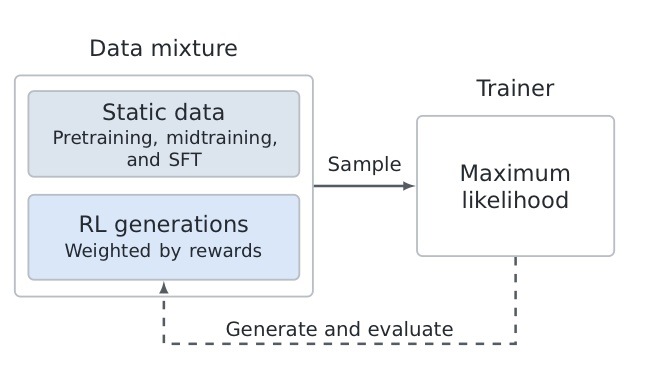
Organizations often know what a better AI answer would look like before they know how to train a model to produce it. The difficult step is translating that judgment into tasks and scores that remain useful when the system starts optimizing against them. Making infrastructure easier does not remove the need to define success carefully.
Trajectory launched its self-service platform on November 2, combining model training, evaluation and deployment around production tasks and scoring criteria. It also announced a $45 million Series A. The release identifies Continual Grading and Group Size 1 as research previews. Those preview labels matter: the product launch should not be read as a claim that every proposed continual-learning capability is already generally available or validated across customers. Read the primary source account.
The customer still supplies the objective
Our analysis is that the platform’s useful abstraction is to let the customer concentrate on the task and its acceptance signal. A team may spend less effort connecting separate infrastructure components. But a model will still learn from the signal it receives, including gaps between the score and the behavior the organization actually wants.
A narrow grading rule can make a task easy to optimize while overlooking important qualities. A broad human judgment may be harder to reproduce consistently. Teams need to establish which parts of the desired outcome can be checked automatically and where expert review remains necessary. Combining the workflow in one product makes those choices easier to operate, not automatically correct.
Production data adds another challenge: the examples that arrive most frequently may not represent the failures with the highest cost. A useful training process needs a way to preserve rare but important cases and to compare new models against stable evaluation material. Otherwise, apparent progress can reflect a changing test rather than a genuine improvement.
Connect training to release decisions
The immediate product change is a single environment in which a team can attempt the train–evaluate–deploy cycle. The important operating discipline is to keep the evaluation decision separate from the desire to ship the latest run. A model that improves the target score may still regress elsewhere or become more expensive under the actual workload.
Longer term, this kind of platform could make domain expertise more directly useful in shaping model behavior. That opportunity depends on reliable scoring, representative data and a controlled route from an experiment to production. It does not follow automatically from self-service access or financing.
The next decisive evidence is a customer evaluation showing a durable improvement under unchanged acceptance criteria, including failures and operating cost. Preview features should be assessed under their stated limitations, with their results kept distinct from capabilities already available in the core platform.
Source organizations: Trajectory.
References
Questions, news tips or corrections? Contact [email protected].