A new workstation arrangement can turn a working robot into another integration project. An operator records examples, engineers adapt a policy, and the revised system needs checking before work resumes. Skild AI’s S1 proposes a shorter first step: show the robot a video and use that demonstration as its task instruction. The model does not update its weights to interpret the example.
S1 was introduced in August 2026. The company’s index dates its technical article August 18, while later company and partner accounts place the public rollout later that month. It is an existing company model announcement, not an October release.
A video carries the sequence that language leaves open
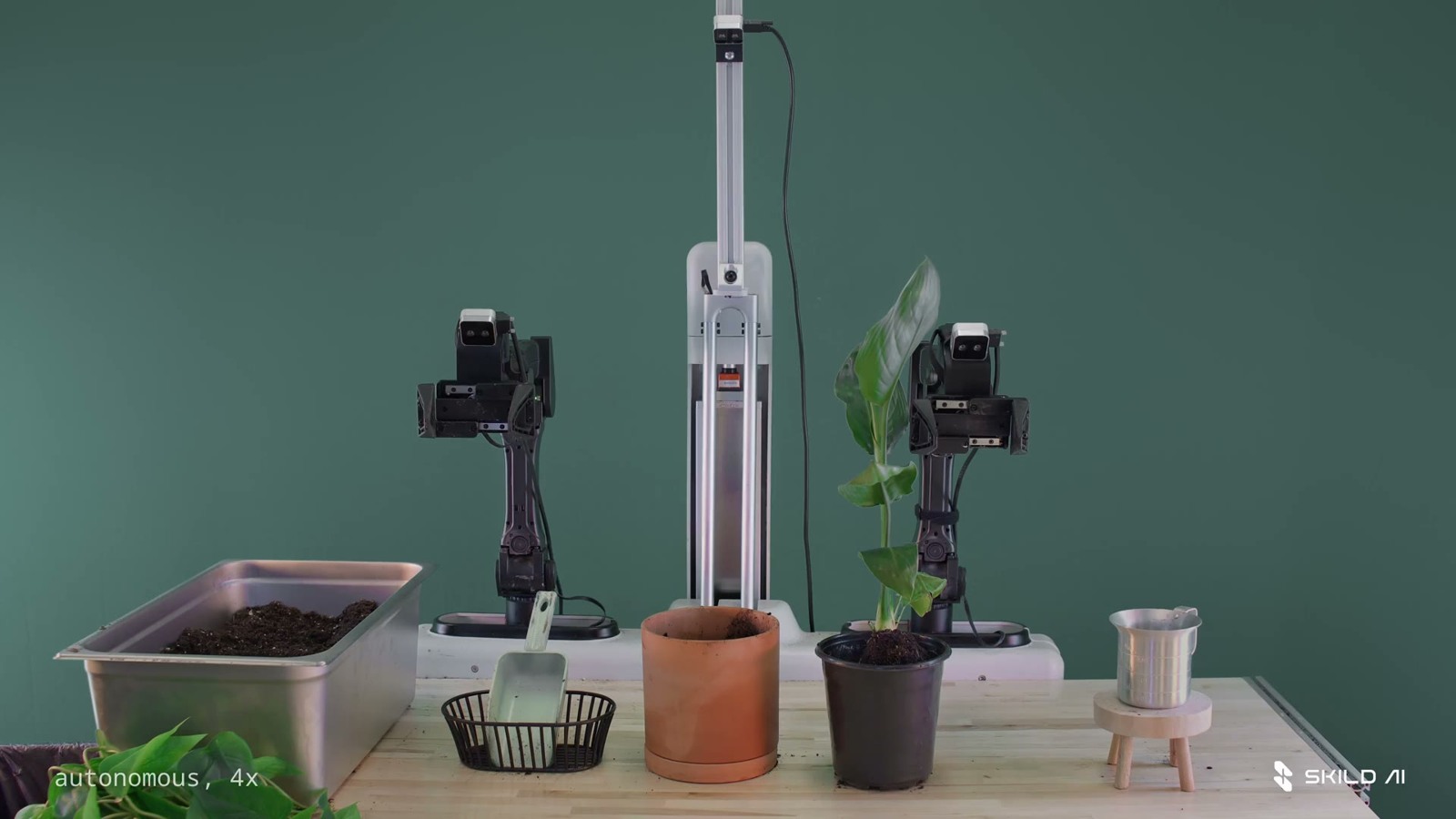
The technical announcement separates familiar from unseen tasks and short actions from long sequences. Skild shows plant potting, pancake preparation, coffee brewing and kit assembly driven by a demonstration. Its claim is that context can communicate both new primitives and unfamiliar combinations of existing ones.
That makes the video more than another training sample. It is part of the inference input, supplying the intended order and manner of work. The model still relies on extensive pretraining; “one demonstration” describes the new task instruction, not its lifetime experience. A team can therefore change what it asks without necessarily creating and maintaining another checkpoint.
The 66% result is not a whole-job completion rate
Skild’s controlled comparison reports 66% against 9% for unseen tasks at the largest tested pretraining scale. The measurement is an average of cumulative per-step success. Humans intervene after failures so later stages can still be graded, particularly for the language-prompted baseline.
This is useful diagnostic evidence: a policy that fails early need not leave every later capability unobserved. It cannot establish that 66% of complete jobs finish without assistance. The release’s long autonomous demonstration clips provide a different kind of evidence from this intervention-assisted comparison.
Conflating the two would turn an informative experiment into an unsupported reliability claim. The distinction also matters economically: an operator needs to know how often a person returns to the workstation, not only whether the robot can perform many of its individual steps.
Deployment changes which adaptation is worth building
Skild’s September account of its commercial work explains why it prioritised this interface. Changing components, layouts and assembly order repeatedly create adaptation work. The company describes planned wire-harness deployment with Sumitomo Wiring Systems and kitchen pilots with Mitsui, alongside its NVIDIA and Foxconn collaboration.
These are different commercial stages, not proof that every S1 demonstration is already a reliable production service. They identify why rapid task specification could matter. A reusable model becomes more useful when the next change can be communicated directly, while additional specialisation remains available for demanding speed and reliability requirements.
Skild explicitly allows that production work may still require training. In-context learning reduces one source of recurring work; it does not abolish validation or make every specialist unnecessary.
NVIDIA’s involvement extends beyond the accelerator
NVIDIA’s September description links the collaboration to data organisation, simulation, reinforcement learning and serving optimisation. It describes Cosmos tools, Isaac infrastructure and work on contact solvers. That is a wider dependency than running one model on a GPU.
For buyers, the stack matters because changing a task instruction does not remove the physical control problem. The robot must still translate the demonstrated intent into its own contacts, observations and timing. A prompt may specify where an object should end up without reproducing the path the human took.
The potentially valuable capability is that translation: retaining the goal while adapting the execution. It should be tested when the scene differs from the video, rather than inferred merely because the robot resembles its demonstrator.
Fast onboarding needs a separate production test
The useful comparison records demonstration time, any further training, intervention frequency and completed work under a time constraint. Those measurements answer whether prompting reduces installation effort while delivering an acceptable service. Neither a selected clip nor a step-level accuracy can supply the entire account.
S1 makes a credible new interface worth investigating. A video can carry enough task structure to let a pretrained policy attempt unfamiliar work immediately. The next commercial milestone is showing how much of the resulting adaptation survives ordinary variation without repeated rescue—and how much specialist engineering remains after the first impressive execution.
References
Questions, news tips or corrections? Contact [email protected].