A video model can help a robot in several ways. It can manufacture training examples, simulate candidate actions or describe what a camera sees. Rhoda AI’s Direct Video-Action approach gives it a more direct role: the predicted future is the policy’s decision about what should happen next.
In its March 10 company research release, Rhoda describes a causal video model paired with an inverse-dynamics translator. The first chooses a visual continuation; the second turns that continuation into robot motion. This division aims to draw broad physical knowledge from web video while using much less robot data to connect that knowledge to a particular embodiment.
The video model chooses; inverse dynamics translates
The system conditions predictions on observed video history, the robot’s own state and other signals such as language. It predicts a short future, converts that video to actions and repeats after receiving new observations. The model is not merely rendering a movie while another policy independently selects every move.
That separation makes the translator’s job more constrained. Given a depicted motion, it estimates how this robot should reproduce it. Rhoda reports training that component with roughly ten hours of embodiment-specific data, including motions that need not be expert task demonstrations. This is a claim about learning the translation interface, not the complete task-learning or pretraining budget.
Actual observations keep replacing imagined history
The company pretrains a causal video model from scratch and uses a context-amortisation objective to learn from long visual histories. During robot control, real observations supply the context. Autoregressively generated videos are also shown for inspection, but they are a different use of the model.
This distinction matters when assessing a convincing forecast. A robot that continually observes the consequences of its actions has opportunities to correct a mistaken prediction. A long generated rollout can drift without receiving that evidence. Watching the latter is useful for debugging; it does not by itself establish closed-loop execution reliability.
Prediction has to overlap movement without fighting it
Rhoda’s leapfrog inference overlaps computation with physical execution. A forecast covers enough future motion for the next inference call to finish while the robot follows the previous command. Conditioning the next prediction on the action already executing is intended to preserve continuity.
This addresses a practical failure mode of generative control. Two individually plausible futures can disagree at their boundary, producing a jerk or oscillation when the controller switches between them. The relevant test is therefore the continuity of successive commands under changing observations, not just the quality of a single predicted clip. Faster generation helps only if its outputs can be joined into usable motion.
The customer demonstrations have a bounded data claim
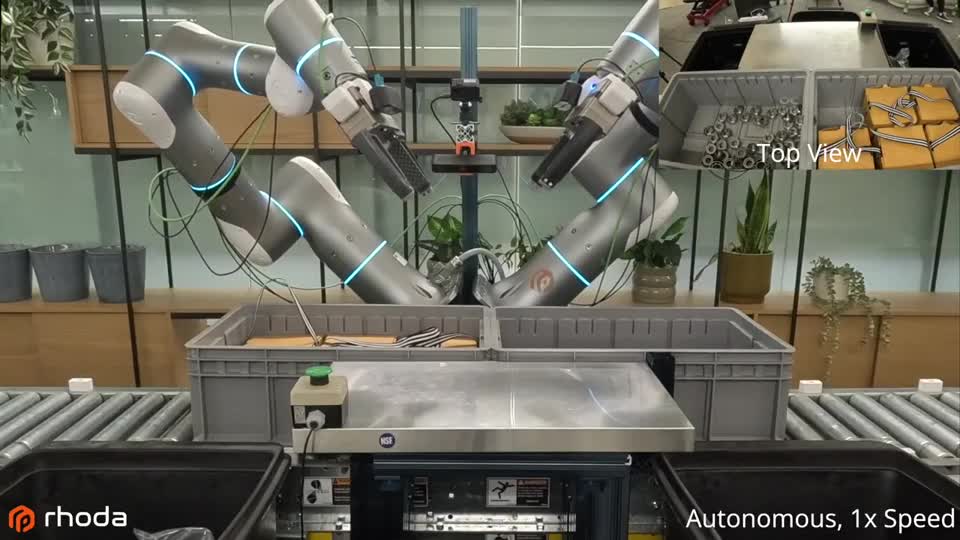
Rhoda reports proof-of-concept tasks for unpacking bearings and breaking down industrial containers, with eleven and seventeen hours of task robot data respectively. The official page links long, uncut demonstrations, including ninety minutes of decanting and 160 minutes of container breakdown. These are company-reported runs in the displayed conditions.
The task data are additional to large-scale video pretraining and should remain distinct from the inverse-dynamics training figure. Describing the system as learning the entire physical world from ten hours would erase the main investment that makes the small adaptation bill plausible. The release also leaves substantial planning and high-degree-of-freedom manipulation challenges open.
A visual decision is inspectable, not automatically justified
Generating the intended future gives engineers something tangible to compare with the resulting movement. They can ask whether the model chose an unsuitable outcome or whether the translator failed to realise a sensible one. That is a useful decomposition of a robot failure into decision and execution.
It does not make the image a guarantee of safety or a faithful verbal explanation. A predicted successful grasp can still be physically wrong. The wider significance is a testable interface between two learning problems: acquiring broad behavioural knowledge and expressing it through a machine. Rhoda’s evidence makes the interface concrete; deployment confidence still requires repeated real execution, interventions and accounting for the work needed to adapt each new task.
Read Rhoda AI’s official announcement and demonstrations.
References
Questions, news tips or corrections? Contact [email protected].