An AI answer can be short and cheap to generate, yet expensive to fix. For teams paying for repeated attempts and human checks, the useful efficiency gain is less work per dependable result. That is the practical stake in Reflection’s Beam: teaching a model to spend its reasoning effort where it helps.
Reflection announced Beam on October 5 with an argument that goes beyond building another large language model: invest in training so the resulting model uses its reasoning budget more effectively. The company describes a 501-billion-parameter mixture-of-experts model, which uses selected specialist components for each step with 23 billion active parameters. Its inference-efficiency claim is worth examining precisely because the model’s training effort and its eventual operating cost are different quantities.
The announcement says the model is undergoing final evaluation, offers early-access registration and promises weights and a technical report later in October. Beam should not yet be presented as a generally downloadable checkpoint on that basis. Axios covered the launch alongside Mistral’s new preview, identifying model control as a central competitive argument.
The training target includes restraint
Reflection describes using a controllable length penalty during reinforcement learning—feedback from successful or failed attempts—to discourage unnecessary tokens while rewarding successful solutions. It reports that reasoning became shorter during an early phase, then expanded again as more difficult capabilities developed. That account is a company-reported training observation, not an independently reproduced law of model improvement.
Shorter reasoning can mean several things. The model may have removed repetition, skipped a useful check or stopped before exploring the difficult part of a problem. Each outcome lowers the text bill, but only the first is an uncomplicated improvement. Training for efficiency therefore needs a test of what work disappeared and whether the answer still holds up.
Count the complete reasoning system
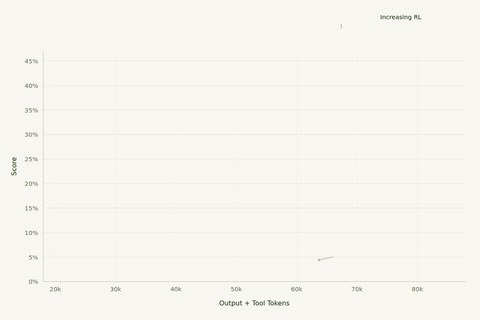
The release’s approximate computation comparison uses active parameters and generated tokens. Reflection explicitly says the estimate excludes input processing, context-dependent attention and serving overhead. That caveat matters. A model operating on a long repository or repeated tool results may spend meaningful resources outside the quantity emphasized in the chart.
For a buyer, the relevant unit is an accepted solution with all attempts included. A short unsuccessful answer followed by several retries may be more expensive than one longer successful run. Tool calls, external services and human checks also belong in the account. An architecture’s theoretical efficiency is useful evidence, but it is not the same as a customer’s measured bill.
Training expenditure and customer value need not move together
A costly training campaign can be rational if its benefit is reused across enough requests. This is the familiar distinction between development expense and marginal operating expense. The business question is how widely a learned improvement generalizes, and how many deployments can reuse it before the model becomes outdated.
Our reading is that this is where an open-weight strategy, which lets others obtain the model’s learned values, becomes interesting. If customers can eventually operate and adapt the checkpoint, the learned efficiency can travel beyond one hosted service. But deployment support and release terms still decide whether that option is practical. The promised artifacts should be evaluated when they arrive, rather than counted as completed value today.
Easy cases can hide expensive failures
Imagine a test set containing routine coding repairs and a smaller number of difficult debugging cases. An average cost reduction may come entirely from the routine group, while the hard cases become less reliable. Reporting both groups makes it possible to decide whether the model should be a general default or a specialist for predictable tasks.
The same test should vary reasoning effort and preserve unsuccessful attempts. A comparison across effort levels would show what additional success is purchased by each increment of computation. That is more informative than a single best score or a single cheapest setting. It also gives model trainers a way to identify whether their length objective improved decision-making or merely changed the model’s presentation style.
Keep hard cases visible in the cost average
Wait for the promised artifacts, then compare independently measured completion cost across difficulty bands and context lengths. The strongest evidence would show that shorter reasoning retains the checks needed for correctness while the full serving system—not just an estimated arithmetic component—becomes more economical.
The larger opportunity is to make dependable AI affordable for more everyday work. Beam will matter commercially if its learned restraint travels to customers’ difficult cases, with the checks that make their results trustworthy still intact.
Questions, news tips or corrections? Contact [email protected].