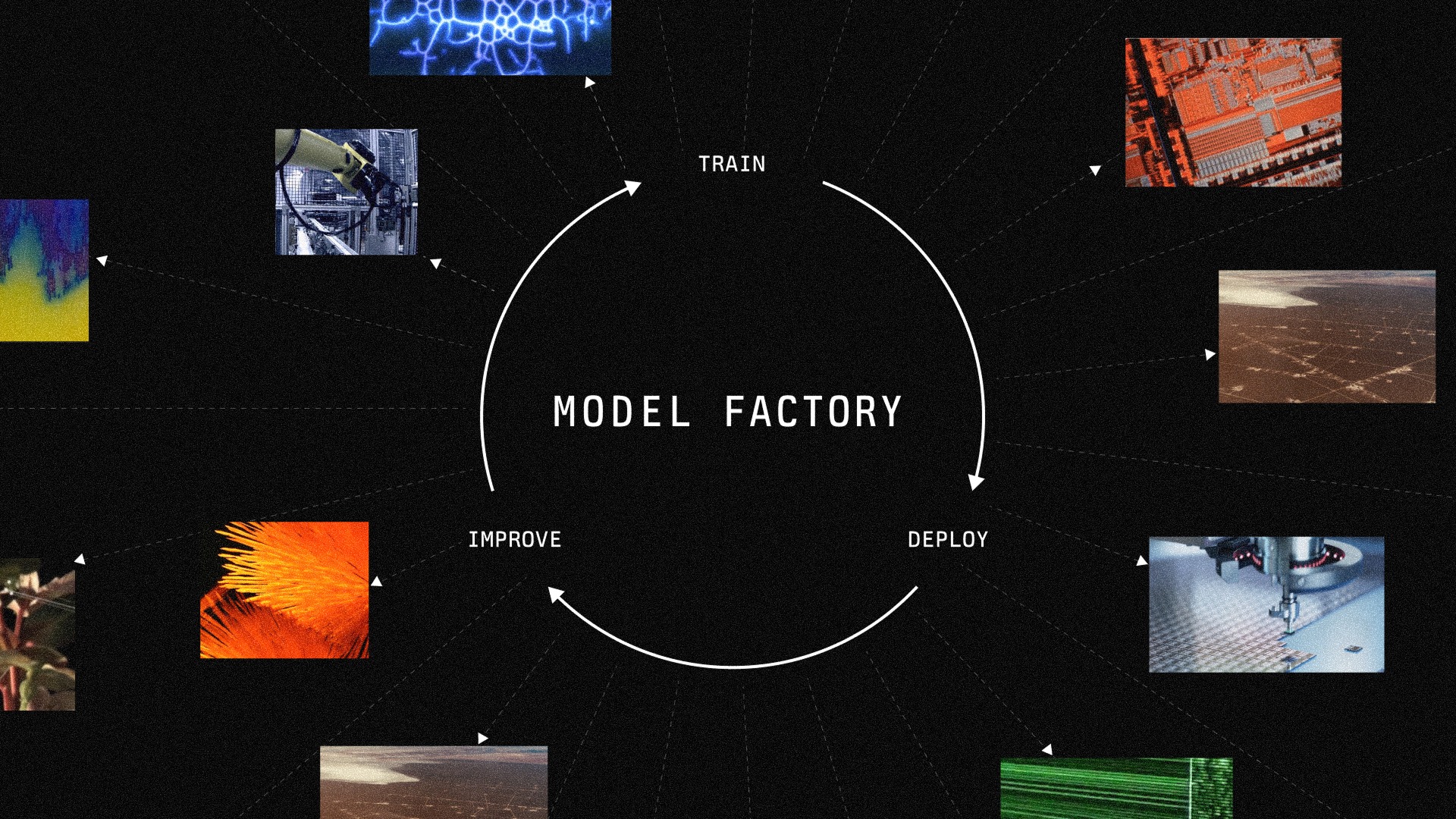
Prime Intellect’s Model Factory proposition brings training, evaluation and inference closer to one operating environment. Its November update describes a system for developing models around a customer’s own workloads. The strategic attraction is a shorter path from observed production behavior to an improved model. The difficult part is deciding which observations should become training evidence and how an improvement is verified.
Infrastructure for a continuing development loop
The Prime Intellect update presents Model Factory alongside training, evaluation, sandbox and inference capabilities. The surrounding release history includes beta services and configuration-specific limitations. These stages should remain explicit. A platform combining several functions does not imply that every training method, model or capacity arrangement is generally available under identical terms.
The important architectural idea is a connected development process. Production traces can reveal recurring failures; evaluation environments can make some of those failures repeatable; training can then target them. Each transition needs a clear record. A trace suitable for diagnosis is not automatically suitable as a positive example or a reward signal.
Select evidence before optimizing it
Production data reflects the behavior of an existing model and the people interacting with it. It may contain incomplete tasks, incorrect tool results or feedback that rewards convenience rather than accuracy. A training pipeline should identify which outcomes have been verified and which remain uncertain. Otherwise a faster loop can reinforce the current system’s mistakes.
Evaluation data also needs separation from the material used to improve the model. Repeatedly training on the same failure cases can improve the visible score without establishing transfer to new cases. A held-out set and a documented sampling method help distinguish a memorized repair from a more general capability gain.
Reproducibility requires more than a checkpoint. The record should identify the base model, dataset version, environment, training configuration and evaluation procedure. Changes in a tool or sandbox can alter an agent’s success even where the weights are unchanged. Keeping those dependencies attached to the result makes later regressions easier to diagnose.
A connected stack can reduce the cost of moving evidence between teams and tools. It can also make an incorrect assumption propagate faster. Ownership of data review, evaluation design and release approval should therefore be explicit. Infrastructure should help maintain those boundaries while making the process easier to execute.
Measure the cost of the complete iteration
A useful comparison would include the effort to collect and review traces, prepare environments, run training, evaluate changes and operate the resulting model. GPU training time alone is an incomplete denominator. A cheaper training run may still produce a model that needs more inference or human correction to complete the same work.
Rollback and retention matter as well. Teams need to know which model and configuration served a particular production interaction, and whether the previous release can be restored. Checkpoint and storage features have different scopes; retaining a filesystem or dataset is not necessarily the same as preserving every part of a running agent environment.
The update establishes infrastructure intended to support continuing model development. The next persuasive evidence is a customer-specific improvement reproduced across a held-out workload, with the complete data and evaluation path documented. That would show whether a faster development loop produces dependable learning rather than simply more frequent model changes.
Sources and media credits
Prime Intellect’s official release artwork. Platform context; individual features retain their documented availability limits. Image: Prime Intellect