When a continued-training model beats one trained from scratch, the result can have several explanations. The models may differ in architecture, vocabulary, training budget or the examples they saw. A practical decision about reusing existing weights needs a comparison that separates those factors. Otherwise, a promising transfer result can be difficult to reproduce or to distinguish from advantages supplied elsewhere in the experiment.
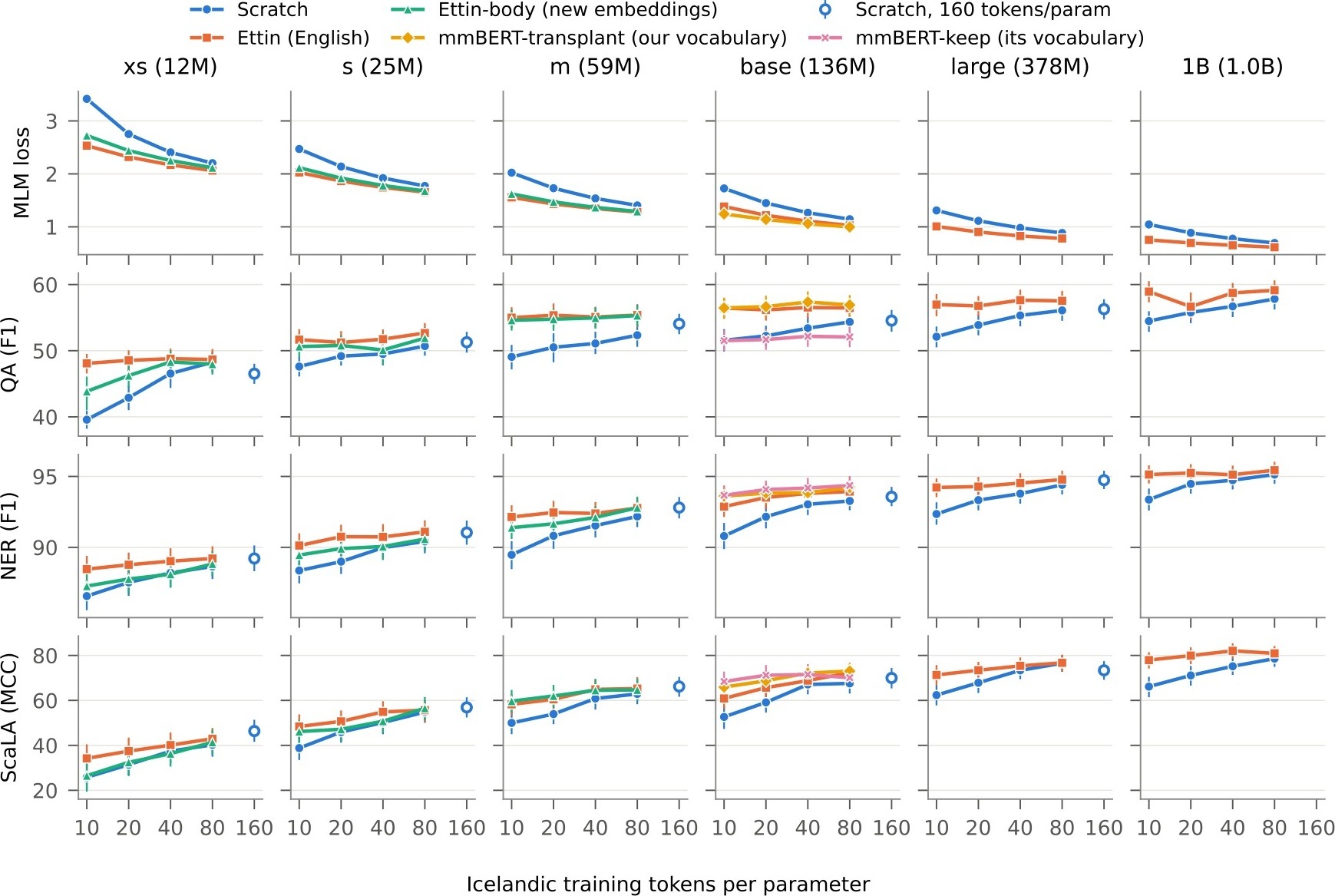
University of Iceland researcher Hafsteinn Einarsson’s October 26 preprint revisits Icelandic encoder training with ModernBERT. It trains models from twelve million to one billion parameters on open text and evaluates thirty encoders under a shared protocol. Matching the shapes of English Ettin encoders permits controlled warm-start comparisons. The study reports that its one-billion-parameter scratch model improves over IceBERT on all eleven evaluated tasks, with the warm-started counterpart performing best on the ranked tasks. Read the primary source account.
Vocabulary is an experimental variable
A language-specific vocabulary affects how text becomes a sequence of model inputs. If a comparison retains one vocabulary for a warm start and uses another for scratch training, it changes more than the starting weights. The paper explicitly investigates that boundary. For researchers working in another language, the relevant lesson is to preserve the vocabulary choice as part of the treatment, rather than assuming that all forms of continued training are equivalent.
The reported transfer finding is therefore conditional on the recipe. It is stronger evidence for the tested setup than a comparison in which model shape, budget and text all move together. It does not establish a universal rule that English initialization is optimal for every language. Different writing systems, corpora and tasks can change which part of an existing model is useful and what has to be relearned.
One evaluation protocol reduces avoidable ambiguity
The benchmark suite includes linguistic analysis and understanding tasks, rather than a single score intended to represent every use. The shared protocol includes confidence intervals and tuning controls. Those details matter when differences are small or training heads respond differently to optimization choices. A model can appear stronger because its downstream setup received more effective tuning, even when the encoder itself contributes less than the headline suggests.
Confidence intervals help distinguish a clear improvement from a numerical ordering that the available evidence cannot resolve. They should travel with task-level results instead of disappearing into an overall ranking. A team choosing a smaller model might reasonably accept a minor score difference for a different resource footprint, but that decision is easier to assess when the uncertainty and the actual task remain visible.
Open training text does not erase evaluation boundaries
The paper’s open-data approach makes the training resource more inspectable, while evaluation still needs its own account of overlap and contamination risk. A result can support a claim about the selected benchmarks without establishing that every Icelandic document or application is equally represented. Users should connect the benchmark tasks to their intended work, especially where a deployment involves specialized vocabulary or a different style of text.
The model ladder is useful because it allows transfer and scaling to be examined together. A finding at one size need not hold with the same magnitude at another. Retaining token budgets and model shapes helps researchers ask whether additional training text, reused weights or greater capacity produced the benefit. That is more actionable than treating all improvement as an undifferentiated consequence of making a model larger.
Task aggregation deserves the same care as initialization. Named-entity recognition, parsing and extractive question answering reward different aspects of an encoder’s representation. An application dominated by one of those tasks may reach a different practical choice from an aggregate leaderboard. Keeping per-task results and confidence intervals available lets users make that choice transparently. It also gives later researchers a basis for identifying whether a new training recipe changes a broad pattern or improves only a narrow part of the evaluation suite.
The immediate contribution is both a set of released encoders and a cleaner test of warm-starting under stated conditions. The wider implication is that lower-resource language work can benefit from controlled comparisons rather than inheriting assumptions from larger-language models. The next evidence to watch is independent reproduction and application-specific evaluation, with vocabulary, data budget and uncertainty preserved. That would show how far the study’s transfer result extends beyond the benchmark suite that established it.
Source organizations: University of Iceland.
References
Questions, news tips or corrections? Contact [email protected].