“Learn from one demonstration” can describe two quite different robot systems. One changes its weights after observing an example. Another keeps its weights fixed and uses the example as context. Generalist’s August 19 GEN-1.5 announcement puts both routes in the same model programme, making the distinction difficult to ignore. The short demonstration is not the whole learning history. It is a way of specifying what an already capable system should do next.
Physical prompting leaves the weights alone
Generalist describes in-context task acquisition from a single three-to-twelve-second demonstration, alongside a separate fine-tuning route using one to ten gradient steps on a few minutes of data. GEN-1.5 is a multimodal model with a thirty-second video-memory window alongside sensor, language and proprioceptive inputs. It produces action trajectories sampled at 100 Hz; that describes the action output, not a claim that a full model inference happens every ten milliseconds. In ten simple, short-horizon tasks, Generalist reports 59% average success from one-shot prompting and 83% after ten gradient steps on five minutes of data per task. Those company-run results establish a narrower scope than general-purpose job learning.
For a deployment team, the routes imply different work. Prompting can make a task change available immediately. Fine-tuning creates another model state that must be versioned and checked. Both may be useful, but an evaluation should identify which one produced the result rather than grouping them under “one-shot learning.”
The prompt contains actions as well as observations
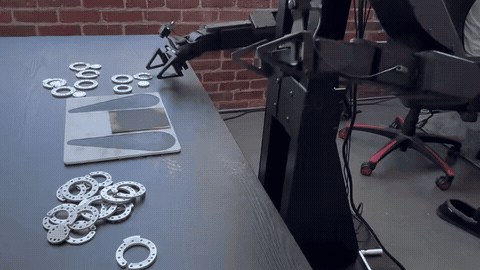
Generalist’s technical account defines physical prompts as sensor data plus action trajectories, recorded with human-operated handheld grippers or as robot rollouts. The demonstration occupies part of the context window; rolling observations fill the remainder. This is a richer interface than dropping an arbitrary web video into a robot.
The company separately shows some cases of a person demonstrating bare-handed in front of the cameras. Those examples should not erase the structured sensorimotor format used for the main prompting account. The precise input matters when comparing data requirements: a short example can be cheap to use while still requiring a particular capture procedure to produce.
The foundation paid for the short lesson
Generalist’s earlier GEN-1 release describes large-scale physical pretraining from human interaction, with robot data used for adaptation. It also presents mastery as a combination of reliability, task speed and recovery, while acknowledging that not every attempted task reaches its strongest reported reliability.
That background changes the economics of the later few-second example. The example can be short because the foundation supplies priors about objects, contact and action. It does not show that a robot could acquire the same breadth from seconds of total experience.
This is the commercially important possibility: expensive shared learning can reduce the marginal cost of specifying another task. The relevant budget includes both, but the two costs are incurred at different points and need not be paid again by every customer.
A demonstration can specify a goal without dictating the path
The distinction between imitation and useful prompting appears when conditions differ. Replaying a recorded trajectory is insufficient if the object moves, the tool changes or the robot’s geometry differs from the demonstrator’s. The model must extract something about intent and translate it into the current interaction.
Generalist’s July account of multiple end effectors provides a related example. It describes one base model working across different contact interfaces and demonstrations of a tool being changed during execution. Those results belong to that earlier programme, but they clarify what a transferable representation would need to preserve: the goal can stay fixed while the means of achieving it change.
This is a more demanding criterion than visual resemblance between demonstration and execution. A different-looking action may be the better imitation of the intended task.
Fast adaptation creates a versioning decision
An inference-time example can remain local to one request or session. A gradient update persists unless the system rolls back or switches checkpoints. That changes how mistakes spread. A poor prompt can derail the current job; a poor update can alter later jobs as well. Conversely, a durable update may remove the need to keep presenting the same example.
The appropriate comparison is therefore not simply which route needs fewer examples. It is how quickly the team can specify, validate, retain or revoke a behaviour. The announcement makes those choices available for investigation, but does not establish that either route is preferable for every workflow.
The useful metric is the work required to introduce the next job
Generalist offers model and hardware access through an expanding programme rather than an unrestricted open-weight release. An operator assessing it needs the full adaptation record: demonstrations, any weight updates, validation runs and intervention during execution. The displayed prompt duration alone cannot supply that account.
GEN-1.5’s contribution is to make task specification look more like an interface to existing physical competence. If the distinction survives independent testing, robot onboarding becomes less about rebuilding a policy for each job and more about choosing how to convey the job—and whether the resulting behaviour should live only in context or become part of the model.
References
Questions, news tips or corrections? Contact [email protected].