A humanoid that works in thirty unfamiliar homes has achieved something different from one that has learned thirty household tasks. Figure’s September 17 Helix 2.5 announcement is interesting because it makes that difference unusually visible. The company specifies behaviours using robot data collected elsewhere, then tests whether those behaviours survive a change of home. The question is whether the next deployment requires rebuilding the lesson.
Zero-shot describes the home, not an untaught task
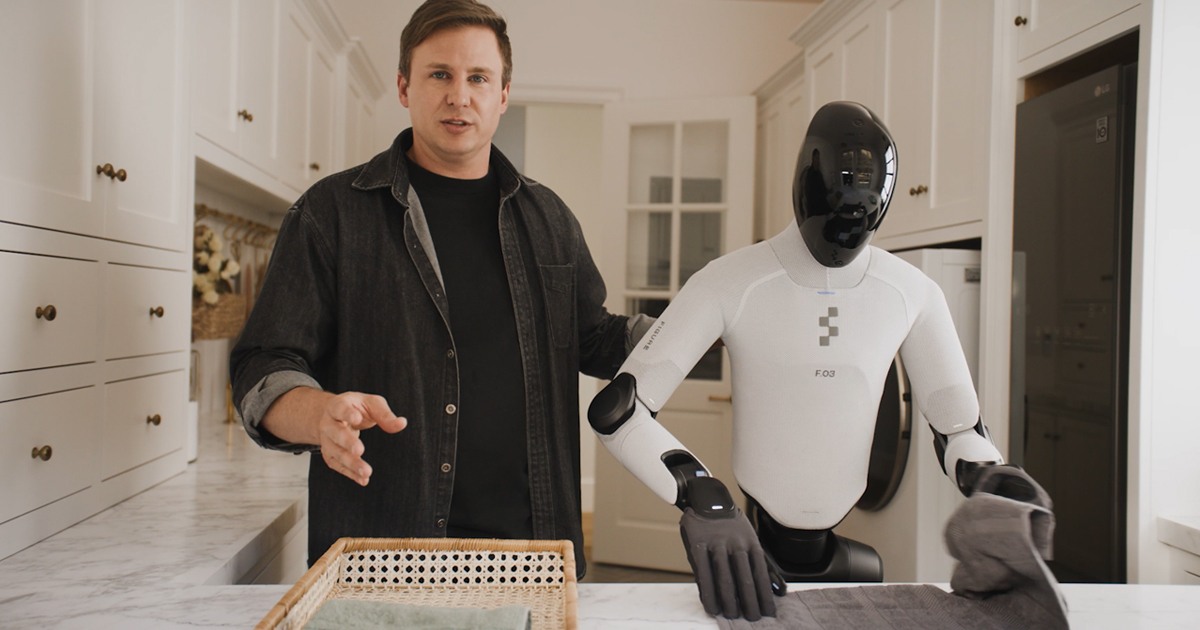
Figure reports three behaviours: room tidying, towel folding and bed making. Each uses a fixed checkpoint across thirty unseen Bay Area homes, with evaluation objects excluded from task-specification data. The tasks themselves were taught. Calling this zero-shot without that boundary would turn an environment-transfer result into a much broader claim about spontaneous household competence.
The distinction changes the product interpretation. A behaviour that must be taught once and a behaviour that must be retaught at every address have different scaling economics. Customers still need to know what the robot can do, but the installation burden could fall if furniture, layout and object variation no longer require a local training campaign.
The strongest comparison holds the robot lessons fixed
The company compares policies trained on identical downstream task data, with architecture and optimisation held constant. Random initialisation produces nine percent success; initialisation from the Index-pretrained model produces fifty-six percent. These are Figure’s results, with whole-task completion required and safety interventions treated as failures.
This does not make fifty-six percent a household reliability specification. It does isolate a more informative variable than a polished demonstration does. The task-specific material becomes substantially more transferable after broad pretraining. That is evidence about what the foundation supplies before a deployment team starts adapting the robot.
The remaining failure rate also matters commercially: a transferable behaviour can still require supervision. Portability and reliability belong on separate axes rather than being collapsed into a declaration that home robotics is solved.
Index is a distribution business as much as a video collection
Figure introduced Index on August 25 as its own pipeline for human physical experience. The company described a consumer app, paid contributors and recordings from many countries. Its processing stages include fraud review, deduplication, rebalancing and hierarchical captions. Those details reveal the operational difficulty behind the appealing phrase “learn from human video.”
A million near-identical chores would not necessarily teach a model how a task changes between homes. The pipeline has to preserve useful variation while removing low-quality or repetitive contributions. That makes contributor incentives and sampling policy relevant to robot capability, even though neither appears in the final robot demonstration.
Index is proprietary. Its launch should not be confused with an open training dataset that other robotics teams can download and reproduce.
Better observations support a transferable policy
The hardware story is complementary. Figure’s earlier Figure 03 announcement describes palm cameras that maintain close-range visibility when the main cameras are blocked, more compliant fingertips and fleet data offload. These are platform features, not a separate measurement of the Helix 2.5 gain.
They nevertheless explain why a visual foundation cannot be evaluated in isolation from its physical interface. A transferable policy still needs observations that reveal the grasp and contact in front of it. Broad experience cannot compensate for every relevant event being hidden from the sensors.
The next unit of progress is the avoided retraining job
The practical follow-up is not another count of attractive homes in a montage. It is a record of what changes when a trained behaviour reaches an unfamiliar site: new demonstrations, calibration, intervention time and retained completion rate. Those measurements would show whether portability reduces installation work while maintaining acceptable service.
Helix 2.5 gives that investigation a concrete starting point. The most consequential possibility is that human-experience pretraining makes robot task data reusable across deployments. If that holds at greater reliability and across a wider task range, a robot company can spend less time teaching the same job at every new address.
References
Questions, news tips or corrections? Contact [email protected].